
Guide
Weekly, Biweekly, or Monthly Payroll: Choosing the Right Pay Schedule for Your Business
Updated September 22, 2026

Key Takeaways
- State payday laws may require specific minimum pay frequencies, especially for hourly and manual workers.
- Biweekly payroll often balances employee expectations, overtime tracking, and administrative costs.
- Monthly payroll can simplify accounting but may not be permitted or practical for every employee group.
- Payroll frequency is separate from IRS tax deposit schedules, which depend on federal employment tax liability.
Choosing a payroll schedule affects when employees receive paychecks, how you handle compliance and overtime, your cash flow, and the time your team spends on admin work each month.
U.S. employers commonly use four schedules: weekly, biweekly, semimonthly, and monthly. The right choice depends on your state's pay laws, your workforce, your cash flow, and what's normal in your industry. Many states set minimum pay frequency rules employers must follow.
Tidy Ledgers Bookkeeping helps businesses weigh these tradeoffs and set up compliant payroll. This article breaks down each schedule so you can pick the one that fits your business.
Payroll Frequency Options Explained
A pay schedule affects your team and your bank account. Each option has its own math and headaches.

There are four common schedules: weekly, biweekly, semimonthly, and monthly. They differ in the number of pay periods each year. Weekly payroll has 52 paydays.
Biweekly has 26. Semimonthly has 24. Monthly has 12.
People often mix up biweekly and semimonthly, but they're not the same. Biweekly means every two weeks, so pay dates shift around the calendar. Semimonthly means twice a month, usually on set dates such as the 1st and 15th, or the 15th and last day of the month. That difference affects payroll math, especially overtime.
| Schedule | Pay Periods per Year | Typical Advantages | Common Drawbacks | Best-Fit Employees |
|---|---|---|---|---|
| Weekly | 52 | Fast access to earned wages, easy budgeting | Higher processing costs, more admin time | Hourly, seasonal, construction, hospitality |
| Biweekly | 26 | Balances cost and pay frequency, simple overtime math | Two months have three paydays, which can complicate cash flow | Mixed hourly and salaried teams |
| Semimonthly | 24 | Fixed dates, easier for salary and bookkeeping | Uneven period lengths, tricky overtime tracking | Salaried staff, office employees |
| Monthly | 12 | Lowest processing cost, simple annual planning | Long gap between paychecks, tough for budgeting | Executives, some salaried roles |
Weekly Payroll: 52 Paychecks per Year
Weekly payroll pays employees every week, for 52 paychecks a year. It's common for hourly, seasonal, construction, and hospitality workers whose hours change from week to week.
Getting paid weekly helps workers manage short-term bills and daily expenses. Money comes in faster, which can make budgeting less stressful. But this schedule doubles your workload compared with biweekly payroll.
You'll run payroll twice as often, which means more time spent on reviews and more fees from your bank or payroll software. If you want help managing that load without losing accuracy, solid payroll services and compliance support can make weekly runs far less painful.
Biweekly Payroll: 26 Paychecks per Year
Biweekly payroll pays employees every other week, for 26 paydays a year. Because 52 weeks don't split evenly into pairs, two months each year have three paychecks instead of two. That's how the calendar falls.
This schedule strikes a balance. Employees get paid often enough to manage bills, while employers avoid running payroll every week.
Biweekly periods also make overtime easier to calculate. Each period covers exactly two workweeks, so hours line up with federal overtime rules as long as time records stay accurate[1].
Semimonthly and Monthly Payroll
Semimonthly payroll pays employees twice a month, usually 24 times a year. Monthly payroll pays once a month, for 12 paychecks. These schedules sound similar to biweekly payroll, but they work differently.
Fixed pay dates, such as the 1st and 15th, or the 15th and last day of the month, make semimonthly and monthly payroll easier to track for salary calculations and bookkeeping. Reports line up with the calendar instead of shifting every week.
Longer gaps between paychecks can strain employee budgets. Some states also set rules for how often workers must be paid, so monthly schedules aren't allowed everywhere[2].
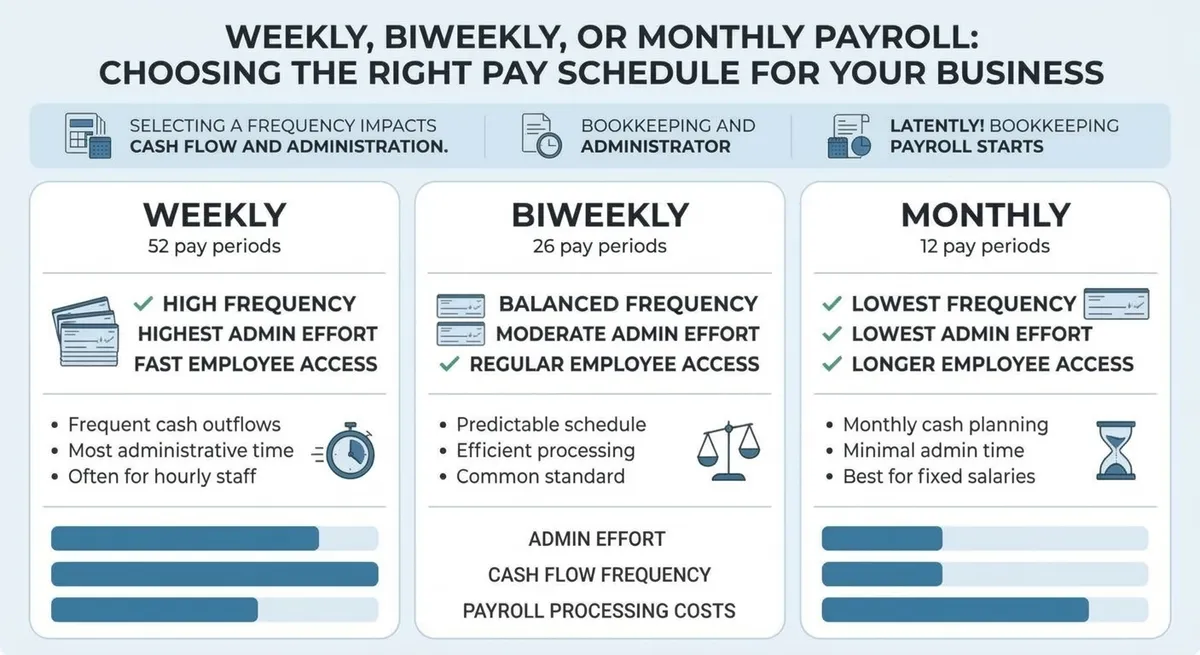
Key data and insights: Weekly, Biweekly, or Monthly Payroll: Choosing the Right Pay Schedule for Your Business
Start With Payroll Compliance Requirements
Before you pick a pay schedule, check the rules. Federal and state laws limit your choices. Skipping this step could lead to fines or back pay claims.
Check State Payday Frequency Laws
Most states set a minimum payday frequency. Some require weekly or biweekly pay for hourly workers. Others apply different rules to manual laborers, commissioned employees, or exempt staff[2].
You can't simply choose the schedule that's easiest for your office. If your state requires weekly pay for certain jobs, monthly pay won't cut it[1]. Always check your state labor agency's current rules before you set or change a schedule.
Account for Overtime and Employee Classification
Nonexempt employees need accurate time tracking regardless of pay frequency. Your pay period can't hide or change your workweek. Overtime still applies to a fixed seven-day cycle, even when paychecks go out biweekly or monthly.
Also double-check who counts as an employee rather than a contractor. Misclassification creates bigger problems than a bad pay schedule. Review your employee classification rules to make sure your team is set up correctly from the start.
Separate Pay Frequency From Tax Deposit Frequency
Many new employers miss this: how often you pay employees has nothing to do with how often you deposit payroll taxes. The IRS sets deposit schedules based on your total tax liability during a lookback period[3]. Depending on that amount, you'll deposit either monthly or semiweekly[4].
You still file Form 941 every quarter to report wages and taxes[5]. Deposits and filings are separate jobs[6]. Missing either one can trigger penalties, even if your employees got paid on time.
Compare Costs, Cash Flow, and Administrative Work
Payroll frequency changes your costs, cash flow, and monthly admin workload as well as your paydays.
| Schedule | Runs Per Year | Processing Frequency | Cash-Outflow Pattern | Month-End Reporting |
|---|---|---|---|---|
| Weekly | 52 | Very high | Steady, small outflows | Often crosses month-end; more accruals needed |
| Biweekly | 26 | High | Frequent, moderate outflows | Two months a year have three pay dates |
| Semimonthly | 24 | Moderate | Predictable, larger outflows | Aligns closely with monthly close dates |
| Monthly | 12 | Low | Large, single outflow | Simplest close, but bigger cash hit at once |
Actual costs depend on your payroll provider, headcount, and benefits setup. No fixed dollar figure applies to every business
Match the Pay Schedule to Your Workforce
Not every team fits one pay schedule. The right choice depends on how your workers are classified and paid. Payroll schedules must follow federal and state law, not just your business preference.

- Hourly and nonexempt: often benefit from more frequent pay
- Salaried and exempt: can often work well with less frequent schedules
- Seasonal: may need short, flexible pay periods
- Commission-based: may require pay cycles that match sales cycles
- Mixed teams: may need more than one pay schedule at once
Hourly and Nonexempt Employees
Hourly workers often prefer more frequent pay. Frequent paychecks give them steady, predictable access to cash for daily bills.
This group also needs careful timekeeping. Hours worked, overtime, and workweek dates must stay consistent and accurateChoose the Best Schedule for Your Business
Picking a pay schedule requires a step-by-step process. Use this framework.
- Verify your state's payday requirements first[2].
- Segment your workforce by job type and pay structure.
- Calculate your annual processing workload for each option.
- Model how each schedule affects your cash flow.
- Assess what your employees actually expect and need.
- Confirm your tax deposit and recordkeeping duties[3].
- Document your final payroll calendar in writing.
Skipping these steps can lead to compliance problems later. Each schedule fits different business needs.
When Weekly Payroll May Be the Right Fit
Weekly pay works best when hours change a lot from week to week. Hourly teams, especially in construction or food service, often expect it. Employees like getting paid often, and frequent paychecks can boost morale.
But there's a cost. More pay runs mean more chances for errors. You'll need solid timekeeping tools and payroll software that can keep up[1]. Without them, weekly payroll can quickly eat up your team's time.
When Biweekly Payroll Is a Practical Default
Biweekly pay hits a nice middle ground. Employees get paid often enough to feel steady, and you're not running payroll every week. Many businesses land here for that reason.
Just remember the math. Biweekly means 26 pay periods a year, not 24. That creates two three-paycheck months, which can confuse employees and complicate benefit deductions. Reviewing your payroll calendar each year can help you plan ahead for those extra-paycheck months instead of being caught off guard.
Switching pay frequencies takes more than flipping a switch in your payroll software. You need a plan. Here's a checklist to keep the change smooth: legal review, employee notice, payroll-system setup, deduction recalculation, bank funding checks, tax-deposit verification, a first-run audit, and record retention.
Plan the Transition and Notice Period
Moving from weekly to biweekly, or biweekly to monthly, can create a short gap or overlap in pay. Some employees may see a paycheck that looks different in size or timing. Planning can prevent that confusion.
Send written notice well before the change takes effect. Explain the new pay-period dates, the first payday under the new schedule, and whether a transition check is coming. Always check state law before you finalize the timeline[2].
Conclusion: Select a Schedule You Can Run Reliably
Balance Compliance, Cost, and Employee Needs
There's no single "best" pay schedule for every business. The right choice depends on your state's rules, your workforce, and your budget.
Before you settle on a schedule, weigh these factors together:
- State payday laws that set minimum pay frequency[2]
- Whether your team is hourly, salaried, or a mix of both
- How often overtime needs to be calculated and paid
- Your cash flow and how often you can cover payroll runs
- The time and cost of running payroll each cycle
- How pay periods line up with your accounting close
- What your employees expect and can plan around
These factors often pull in different directions. A schedule that saves on admin costs might strain cash flow. One that keeps employees happy might add processing time each month[1].
That's why it helps to write things down. Build a payroll calendar for the year and mark pay dates, tax deposit due dates, and reporting deadlines. Review it once a year, especially after you hire new staff, open in a new state, or change your growth plans. Our guide on payroll tax deadlines and deposit schedules can help you plan around key dates as your business grows.
Get Support With Payroll Planning and Compliance
Choosing a pay schedule is just the first step. Running it correctly, week after week, protects your business.
Tidy Ledgers Bookkeeping helps small businesses manage payroll processing, tax deposit coordination, and account reconciliations. We work with you to build a payroll routine that fits your cash flow and keeps you compliant.
Want fewer payroll errors and a process you can count on? Explore our payroll services and reach out to talk through the best schedule for your team.
Frequently Asked Questions
Is biweekly or semimonthly payroll better for a small business?
It depends on your workforce. Biweekly payroll gives employees 26 paychecks a year and tends to work well for hourly or mixed teams because it lines up with weekly overtime calculations. Semimonthly payroll gives 24 paychecks on fixed dates, like the 1st and 15th, or the 15th and last day of the month, which can make salary payments and month-end accounting simpler. In the end, state payday laws and employee expectations will usually decide which one makes more sense for you.
Does paying employees monthly reduce payroll tax responsibilities?
No, how often you pay employees has nothing to do with how often you deposit payroll taxes. The IRS sets your federal deposit schedule based on your total tax liability, not your pay frequency. So even if you switch to monthly payroll, you'll still need to follow your assigned deposit schedule and file all required payroll tax forms on time.
Can a business change from weekly to biweekly payroll?
Yes, most businesses can make this switch, but it takes planning. Check your state's payday laws, since some states set minimum pay frequency rules that differ for hourly workers and salaried staff. Review employee notice requirements, deduction schedules, and cash flow before making the change, then update your payroll system settings. Build a transition calendar and run a test payroll cycle before going live so you can catch errors early.
Conclusion
There's no single right answer here. The best payroll schedule meets your state's pay frequency rules, keeps overtime and tax withholding accurate, and works with your cash flow. Biweekly payroll suits many businesses, but weekly, semimonthly, or monthly schedules can work better depending on your workforce and how you operate.
Remember, your pay schedule and your IRS tax deposit schedule are two different things. Mixing them up can cause compliance headaches.
Switching schedules or setting one up correctly the first time isn't something to guess at. A payroll professional can walk through the numbers, handle the transition, and keep your records clean.
Contact Tidy Ledgers Bookkeeping to discuss payroll services, compliance support, and a pay schedule built around your business.
Related Articles
- PayrollAccurate payroll with Idaho withholding, unemployment, and W-2 / 1099 filings handled for you
- GuideBookkeeping for Restaurants: Managing Tips, Inventory, and Daily SalesMaster bookkeeping for restaurants with tips, inventory, POS sales, payroll, and tax guidance. Cut errors, track costs, and protect profits-read now!Read the guide
- GuideEmployee or Independent Contractor? A Simple Classification Guide for Small Business OwnersEmployee or independent contractor? Learn IRS and DOL classification rules, avoid costly misclassification penalties, and protect your small business today.Read the guide
- GuideWho Needs A 1099-NEC: Contractor Rules for This YearLearn who needs a 1099-NEC, key payment thresholds, exceptions, and deadlines. Get contractor reporting right-review the rules and prepare before year-end.Read the guide
- Guide1099 Deadlines for Small Businesses: What to File and When1099 deadlines for small businesses made simple: learn 1099-NEC and 1099-MISC due dates, e-filing rules, and tips to avoid penalties. Read now!Read the guide
- GuideW-9 Collection Tips to Avoid 1099 Filing HeadachesW-9 collection tips to prevent 1099 filing headaches: verify contractor details, secure forms, and avoid IRS notices with a smarter tracking process.Read the guide
Common questions
Is biweekly or semimonthly payroll better for a small business?
It depends on your workforce. Biweekly payroll gives employees 26 paychecks a year and tends to work well for hourly or mixed teams because it lines up cleanly with weekly overtime calculations. Semimonthly payroll gives 24 paychecks on fixed dates, like the 1st and 15th, which can make salary payments and month-end accounting simpler. In the end, state payday laws and what your employees expect will usually decide which one makes more sense for you.
Does paying employees monthly reduce payroll tax responsibilities?
No, how often you pay employees has nothing to do with how often you deposit payroll taxes. The IRS sets your federal deposit schedule based on your total tax liability, not your pay frequency. So even if you switch to monthly payroll, you'll still need to follow your assigned deposit schedule and file all required payroll tax forms on time.
Can a business change from weekly to biweekly payroll?
Yes, most businesses can make this switch, but it takes some planning first. Check your state's payday laws, since some states set minimum pay frequency rules that differ for hourly workers versus salaried staff. You'll also want to review employee notice requirements, deduction schedules, and your cash flow before making the change, then update your payroll system settings. It helps to build a transition calendar and run a test payroll cycle before going live, so you can catch any errors early.

Want this handled for you?
Get a free, no-obligation quote and a quick health check of where your books stand. We reply within one business day. No pitch, no pressure.