

Key Takeaways
- Request a completed Form W-9 before making the first payment to a contractor or vendor.
- Verify legal names, taxpayer identification numbers, entity types, and addresses before year-end.
- Use a secure digital collection process and maintain an organized W-9 tracking system.
- Understand when missing or mismatched information may lead to backup withholding or IRS notices.
A missing or inaccurate Form W-9 can turn a simple contractor payment into a January 1099 filing scramble. For payments made through the end of 2025, the IRS requires a correctly filed 1099-NEC once you pay a contractor $600 or more in a year; starting with payments made in 2026, that reporting threshold rises to $2,000 under the One Big Beautiful Bill Act (OBBBA), and it will adjust for inflation each year after that. Either way, accurate filing starts with good W-9 data collected up front [5].
Many small businesses wait until tax season to chase down names, addresses, and Taxpayer Identification Numbers. By then, incomplete forms and wrong TINs can lead to IRS notices or backup withholding [15].
This article walks through a simple system to collect, verify, track, and store W-9s before the first payment, so year-end filing stays calm instead of chaotic.
Why W-9 Collection Matters for 1099 Compliance
Form W-9 and Form 1099 work as a team. Miss one step, and the whole process falls apart come tax season. Knowing what each form does helps you avoid last-minute scrambling.
| Document | Purpose | Who Completes It | Recipient | Typical Timing |
|---|---|---|---|---|
| Form W-9 | Collects taxpayer info from a payee | The contractor or vendor | The business (kept on file) | Before the first payment |
| Form 1099-NEC | Reports payments made to a contractor | The business (payer) | Contractor and IRS | By January 31 each year |
| Form 1099-MISC | Reports other payment types like rent | The business (payer) | Recipient and IRS | Recipient copy due January 31; IRS copy due by set IRS deadlines each year (typically late February for paper filing, late March for e-filing) |
For payments made in 2025 and earlier, the IRS ties these forms to a general $600 threshold for 1099-NEC and 1099-MISC reporting. Under the OBBBA, that threshold rises to $2,000 for payments made starting in 2026, with annual inflation adjustments beginning in 2027, so always confirm the threshold that applies to the tax year you're filing for.
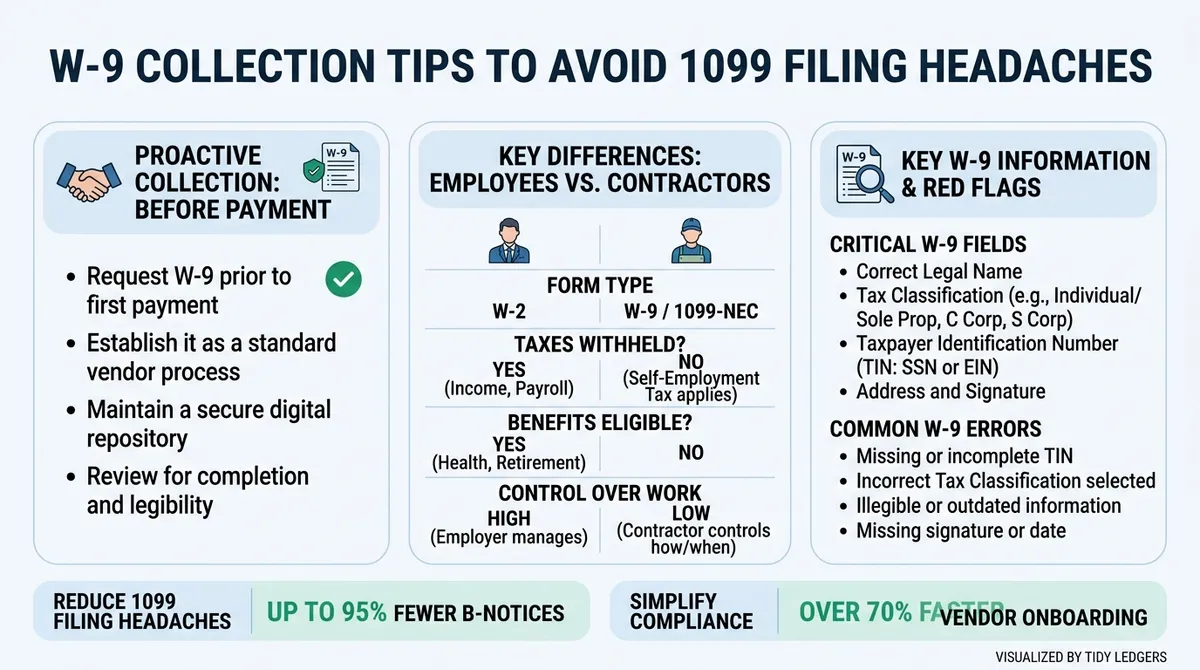
Key data and insights: W-9 Collection Tips to Avoid 1099 Filing Headaches
Build a Reliable W-9 Collection Process
A good process beats good intentions every time. If you wait until January to chase down W-9 forms, you're already behind. Build collection into steps you already take.

Request the Form Before the First Payment
Make W-9 collection part of onboarding, not an afterthought. As soon as a contractor signs an agreement, send the W-9 request. Do this before sending any money.[3].
Tie the request to a trigger you can't skip, like a signed contract or a new vendor setup form. Waiting until year-end creates a scramble. Early collection gives you time to fix errors or chase missing details before it turns into a deadline crisis tied to 1099 filing deadlines.
Use a Secure Digital Intake Method
Don't ask for W-9 forms over regular email. Taxpayer ID numbers are sensitive, and many practitioners advise against emailing completed W-9 forms because standard email isn't considered secure enough for that kind of data. A secure portal or protected digital form is a better choice.
Digital forms also cut down on messy handwriting and copy errors. Structured fields prompt people to fill in every box. Limit access to these records to the staff who truly need them, and never leave copies in open shared folders.
Need help managing contractor paperwork and year-end filings? Ask Tidy Ledgers Bookkeeping about contractor onboarding and 1099 support built for small business teams.
Track Outstanding Forms With a W-9 Register
A simple register keeps missing forms from slipping through the cracks. List each vendor, the onboarding date, request date, and receipt date. Add entity type, TIN verification status, and the last review date too.
Assign a follow-up owner and a deadline for each outstanding form. Nobody should wonder who's responsible for chasing a late W-9. This tracking also matters if a vendor's information doesn't match IRS records, which can trigger backup withholding requirements[15].
Before year-end, reconcile your register against actual contractor payments and your general ledger. This catches mismatches early and helps confirm you're issuing 1099s only to vendors who cross the applicable reporting threshold for that tax year[7], with the forms coded correctly from the start[1].
Review Every W-9 for Common Errors
Even a small mistake on a W-9 can cause big headaches later. Before you file it away, run through a quick quality check for accurate payroll and 1099 filings down the road.

- Identity: Does the name match official tax records?
- Tax classification: Is the entity type checked and correct?
- TIN: Is the number complete and readable?
- Address: Is it current and usable for mailing forms?
- Certification: Is the form signed and dated?
- Update triggers: Has anything changed since the last form was filed?
Always follow the current IRS form instructions [2] instead of guessing based on an invoice. A vendor's business name on paperwork doesn't always match their legal tax name.
Check the Legal Name and Tax Classification
Start with the name field. It should show the taxpayer's legal name, not just a brand or project title.
Next, look at the tax classification box. Is the payee an individual, sole proprietor, partnership, or corporation? Getting this wrong can affect how you handle 1099 reporting requirements [1] later.
If a vendor uses an assumed business name, that name usually needs a separate line. The legal name still has to appear first.
Verify the TIN, Address, and Signature
Check that the taxpayer identification number is complete and easy to read. A missing digit or transposed number can trigger IRS penalty notices[12].
Confirm the address is current, since it affects where forms and notices get sent. Also check that the certification section is signed and dated when required[4].
Name-TIN mismatches are reportedly one of the most common filing problems businesses run into[3], though no official IRS statistic quantifies exactly how frequent these errors are. Catching these early saves time and stress.
Know When a New W-9 Is Needed
Ask for a new W-9 whenever a payee's entity type, name, address, or ownership changes. Don't assume an old form filed years ago is still accurate.
Review long-term vendor files periodically instead of leaving them untouched. If you spot an issue on a submitted form, never edit it yourself.
Instead, ask the contractor to clarify or send a corrected version.
Connect W-9 Data to Contractor Payments
A W-9 form is just the start. You still need to track what you pay each contractor all year long. Without good records, January turns into a scramble.
A simple payment-tracking table can save you hours. Here's an example of what to track for each contractor. (These are illustrative example figures, not real contractor data.)
| Contractor Name | Payment Date | Payment Method | Expense Category | YTD Total | W-9 Status | Potential 1099 Status |
|---|---|---|---|---|---|---|
| Jane Rivera | 03/14 | ACH transfer | Design services | $2,100 | Received | Likely NEC |
| Marcus Cole | 05/02 | Credit card | IT support | $450 | Pending | May not apply (below the applicable reporting threshold for the tax year) |
| Delgado Landscaping LLC | 07/19 | Check | Grounds maintenance | $3,800 | Received | Likely NEC |
Notice the credit card payment above. Card and third-party network payments often get reported by the payment processor on Form 1099-K instead, not by you.
Handle Missing W-9s, Mismatches, and Backup Withholding
Even with a good system, some W-9s never come back, and others come back with errors. Document the request, follow up in writing, review what you get, explain the issue clearly, apply withholding if needed, and escalate when nothing works.

This section covers general bookkeeping practices. It's not a substitute for advice from a tax professional who knows your business.
Follow Up When a Contractor Does Not Return a W-9
Don't wait until January to chase down a missing form. Ask for the W-9 before you send the first payment. Send a second request if a week or two passes with no response.
Keep a simple log of every request you send. Note the date, method, and any reply. Save emails, returned mail notices, and text confirmations too.
This record matters if the IRS ever asks why a form is missing or late.Prepare for 1099 Filing Before January
Waiting until January to start 1099 prep creates stress. Spread the work across the year instead. Onboard vendors with a W-9 as soon as you agree to pay them.
Review payments each quarter to catch anyone who crossed the applicable reporting threshold for that tax year[7]. Build a report of outstanding W-9s in November. Reconcile everything in December, then prepare and review forms in January before confirming submission on deadline day.
Penalty amounts change from year to year. Don't rely on last year's numbers. Always check current IRS penalty tiers before assuming you know the cost of a late or missing form[12].
Use a Year-End W-9 Reconciliation Checklist
Before preparing a 1099, compare your W-9 register against other records. Check it against your vendor master file, contractor ledger, accounts payable report, and payment processor data. This catches problems early.
Look for missing forms, duplicate vendor entries, closed accounts, and old addresses. Also flag any entity classifications that look off, like a contractor now filing as an S-corp[1]. Make sure every contractor total matches your books and payment records before you build a single form. Good business record retention habits make this whole process faster.
Plan Around the January 31 Deadline
Form 1099-NEC generally needs to reach both the recipient and the IRS by January 31[3]. Form 1099-MISC recipient copies are also generally due by January 31, but the IRS copy typically follows a later deadline (usually late February for paper filing or late March for e-filing). Any of these dates can shift for weekends, holidays, or rule updates, so always confirm the current year's deadlines[4].
If you wait until January to fix bad names, TINs, or addresses, you're out of time. Set your own internal deadline in November or December for outstanding W-9s. Give your team room to clean up data before the real deadline hits.
Retain W-9s and Supporting Records Securely
Keep W-9s, payment reports, correspondence, filed forms, corrections, and withholding records together. Use an organized system with limited access. This protects sensitive data and makes audits far less painful.
Retention periods can vary depending on the record and your tax situation. Follow current IRS guidance and check with your tax professional. A consistent naming and review system means you can pull any file fast if a notice ever shows up.
Avoid Costly 1099 Filing Mistakes
Mistakes happen. What matters is how fast you fix them.
> "Early correction of a 1099 error is generally less costly than discovering the same error after the filing deadline has passed, according to industry compliance guidance."
Waiting to fix a bad form almost always costs more than catching it early.
Correct Errors Promptly and Document the Fix
Common 1099 errors include wrong TINs, misspelled names, missed contractors, duplicate forms, and payment totals that don't match your records.
The right fix depends on the mistake. It also depends on whether you've already filed or sent the form to the contractor[2]. Some errors need a corrected form. Others just need updated internal records[4].
Keep a simple paper trail. Note what changed, why, and when you sent the correction. This protects you if the IRS ever asks questions[3].
Understand the Financial Impact of Late or Incorrect Forms
Penalties usually get bigger the longer you wait to fix things[8]. For returns due in 2026, correcting a form within 30 days sits in the lowest penalty tier (around $60 per form), while waiting until after August 1 (or not filing at all) pushes you into a much higher tier (around $340 per form), so filing a corrected form promptly costs meaningfully less than waiting until August.
Information-return penalties vary by tax year and by how promptly the return is corrected. Consult the current IRS penalty schedule rather than relying on a generalized per-return range.[9][10]. These numbers shift from year to year, so always check current IRS guidance before budgeting for penalties[11].
An honest mistake is one thing. Intentional disregard is another. The IRS treats deliberate non-filing far more harshly, with penalty exposure (around $680 per form, with no cap, for returns due in 2026) that can climb well beyond standard late-filing tiers[12].
- Small errors caught early (generally corrected within 30 days): lowest penalty tier
- Corrections filed after the deadline (generally after August 1 or not filed): higher tier
- Never filed or willfully ignored: steepest, uncapped penalties
Know When to Bring in a Bookkeeping Professional
Some situations call for extra help. If you manage dozens of contractors, use several payment platforms, or you're untangling a prior-year mistake, a professional saves time and stress.
The same goes for backup withholding issues or an IRS notice sitting in your inbox. A bookkeeper can organize your W-9 collection process from the ground up. They'll reconcile contractor payments against your books and get everything ready before deadlines hit.
Tidy Ledgers Bookkeeping reportedly handles payroll, contractor tracking, and year-end filing prep, so you're not scrambling every January.
Frequently Asked Questions
Do I need a W-9 from every contractor?
It's smart to get a W-9 from every contractor before you pay them, even if you're not sure you'll cross the filing threshold. For payments made through 2025, the IRS generally requires a 1099-NEC for any contractor paid $600 or more in a year; for payments made starting in 2026, that threshold rises to $2,000 under the OBBBA, adjusted for inflation annually starting in 2027. You won't always know upfront how much you'll pay someone over time, so collecting the form early saves you from chasing it down later, which is one of the biggest causes of 1099 filing delays. That said, actual 1099 reporting depends on the payment type, how the payee is classified, the reporting threshold in effect for that tax year, and certain exceptions, so the W-9 is just the first step.
What should I do if a contractor refuses to provide a W-9?
First, ask more than once and keep a record of each request, including dates and how you asked. If a payee does not provide a taxpayer identification number or another backup-withholding trigger applies, review the current IRS rules promptly; backup withholding may be required at the rate specified for the applicable tax year (24% as of the current rate). Don't guess at their tax status or make assumptions about their TIN. Talk to a tax professional before you decide how to handle payments going forward, since getting this wrong can lead to penalties.
What happens if the W-9 name and TIN do not match?
A mismatched name and TIN is reportedly one of the most common causes of 1099 filing errors, and it can trigger an IRS notice. Reach out to the payee right away and ask for a corrected W-9 with accurate information. Keep copies of your requests and any responses you get, since that paper trail matters if the IRS follows up. If the IRS sends a mismatch notice and the payee does not resolve the issue through the required solicitation process, backup withholding may be required at the rate specified for the applicable tax year (24% as of the current rate).
Conclusion
Good W-9 habits save you from January panic. Collect the form before you send that first payment, not after. Check names, TINs, and entity types while you still have time to fix mistakes. A little organization now means fewer corrected 1099s and fewer IRS notices later.
Think of your W-9 process as insurance. It protects your business if questions ever come up about a payment or a contractor's information. Build a simple system, stick to it, and year-end filing stops feeling like a scramble.
Need help getting your contractor records in order? Tidy Ledgers Bookkeeping can help you collect W-9s, organize payment totals, and get ready for a smoother 1099 season. Reach out today and take the stress out of filing.
Related Articles
- GuideWho Needs A 1099-NEC: Contractor Rules for This YearLearn who needs a 1099-NEC, key payment thresholds, exceptions, and deadlines. Get contractor reporting right-review the rules and prepare before year-end.Read the guide
- Guide1099 Deadlines for Small Businesses: What to File and When1099 deadlines for small businesses made simple: learn 1099-NEC and 1099-MISC due dates, e-filing rules, and tips to avoid penalties. Read now!Read the guide
- PayrollAccurate payroll with Idaho withholding, unemployment, and W-2 / 1099 filings handled for you
- Financial Reporting & InsightsClear monthly reports, AP/AR, 1099s, and KPIs that turn your numbers into confident decisions
- GuideBookkeeping for Contractors: Tracking Job Costs, Materials, and Subcontractor PaymentsBookkeeping for contractors made easier: track job costs, materials, subcontractor payments, retainage, and 1099s to protect margins. Learn how today!Read the guide
- GuideYear-end bookkeeping checklist for Idaho small businessesA step-by-step year-end bookkeeping checklist built for Idaho small businesses, with timing and the exact items to square away before you hand your books to your tax preparer.Read the guide
Common questions
Do I need a W-9 from every contractor?
It's smart to get a W-9 from every contractor before you pay them, even if you're not sure you'll hit the $600 filing threshold. The IRS generally requires a 1099-NEC for any contractor paid $600 or more in a year, but you won't always know upfront how much you'll pay someone over time. Collecting the form early saves you from chasing it down later, which is one of the biggest causes of 1099 filing delays. That said, actual 1099 reporting depends on the payment type, how the payee is classified, and certain exceptions, so the W-9 is just the first step.
What should I do if a contractor refuses to provide a W-9?
First, ask more than once and keep a record of each request, including dates and how you asked. If they still won't provide one, look into current backup withholding rules, since you may need to withhold 24% from future payments. Don't guess at their tax status or make assumptions about their TIN. Talk to a tax professional before you decide how to handle payments going forward, since getting this wrong can lead to penalties.
What happens if the W-9 name and TIN do not match?
A mismatched name and TIN is one of the most common causes of 1099 filing errors, and it can trigger an IRS notice. Reach out to the payee right away and ask for a corrected W-9 with accurate information. Keep copies of your requests and any responses you get, since that paper trail matters if the IRS follows up. If the mismatch isn't fixed, you may need to apply backup withholding at a flat 24% rate on future payments to that person.

Want this handled for you?
Get a free, no-obligation quote and a quick health check of where your books stand. We reply within one business day. No pitch, no pressure.