

Key Takeaways
- Businesses generally issue Form 1099-NEC to eligible nonemployee service providers who meet the applicable annual reporting threshold.
- Worker status, payment method, business structure, and service type determine whether a 1099-NEC is required.
- Payments by credit card or third-party networks are excluded from Form 1099-NEC; the payment processor may instead report them on Form 1099-K, but only if it meets the $20,000 and 200-transaction threshold, so many smaller card payments may not generate any 1099-K at all.
- The 1099-NEC deadline is typically January 31. Start collecting W-9 information and matching payments before year-end.
A contractor may finish the year with a full payment history and still not need a 1099-NEC. That mistake is common. Once tax season arrives, small businesses can mix up contractors, employees, vendors, and payment processors. Then the paperwork piles up fast.
So who needs a 1099-NEC? The answer depends on several details: the work performed, the amount paid, the recipient, and the payment method. Even the dollar threshold can change: recent legislation (the "One, Big, Beautiful Bill Act") raises the 1099-NEC and 1099-MISC reporting threshold from $600 to $2,000 for payments made after December 31, 2025, with inflation indexing starting in 2027. Check the latest IRS instructions before filing to confirm which threshold applies to the tax year you're reporting.
This guide explains each rule in plain language.
Who Needs a 1099-NEC This Year?
In simple terms, a business usually files Form 1099-NEC after paying a nonemployee for services above the reporting threshold. The basic rule sounds easy. The details cause trouble for many small business owners. Use the table below for a quick check, then confirm your answer with current IRS instructions.
| Payment Recipient | Service Provided | Annual Amount | Payment Method | Likely Form | Final Review Needed |
|---|---|---|---|---|---|
| Freelance writer | Content writing | $750 | Check | 1099-NEC | Yes, confirm current threshold |
| IT contractor | Network setup | $3,200 | ACH transfer | 1099-NEC | Yes, confirm current threshold |
| House cleaner (personal home) | Cleaning service | $1,500 | Cash | None (personal payment) | Yes, confirm business vs. personal use |
| Vendor paid by credit card | Graphic design | $2,000 | Credit card | No 1099-NEC (card payments are excluded); a 1099-K is unlikely at this amount since the processor's threshold is $20,000 and 200 transactions | Yes, confirm payment method rules and current 1099-K threshold |
The Basic 1099-NEC Test for Businesses
The 1099-NEC is an information return. It reports nonemployee compensation paid for services performed in a trade or business
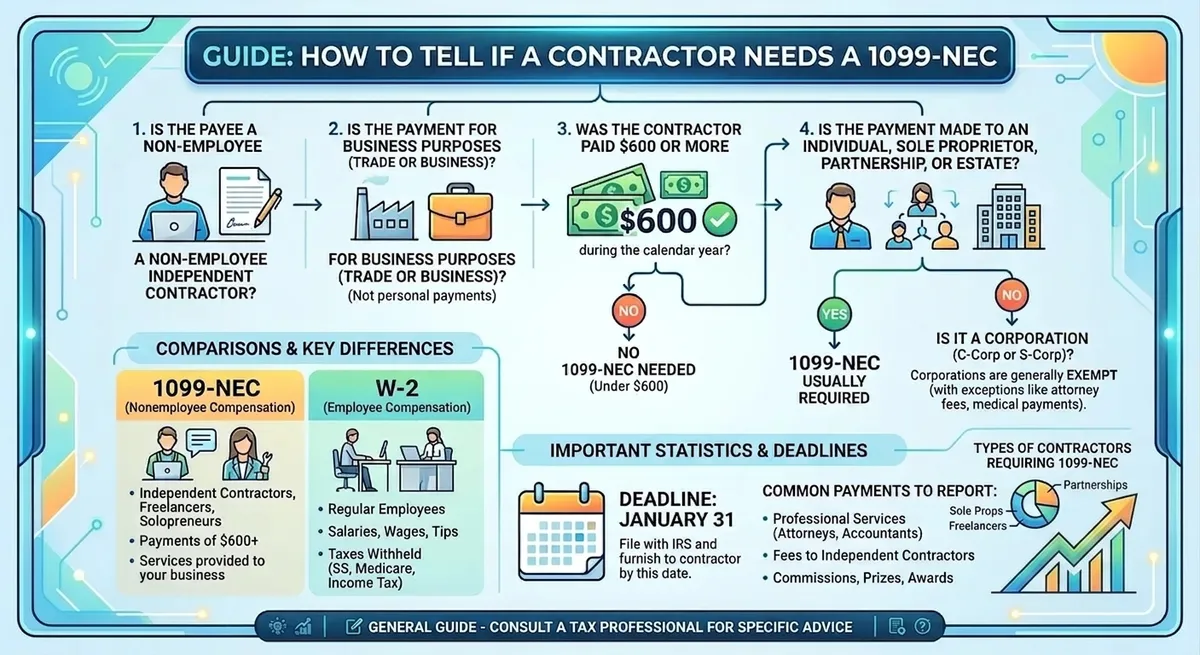
Key data and insights: Who Needs A 1099-NEC: Contractor Rules for This Year
Which Contractors Usually Receive Form 1099-NEC?
If you're asking who needs a 1099-NEC, start with the person you paid for work. Don't rely on the title on the invoice. The IRS looks at the service and payment amount, not the worker's job title.[13] Many businesses face this question at year-end. It helps to know which workers usually require a filing.

The answer gets clearer when you sort contractors into a few common groups. Here are the main categories that business owners see each tax season.
Freelancers, Consultants, and Professional Service Providers
Freelance writers, designers, and developers are common 1099-NEC recipients. The same often applies to consultants, bookkeepers, marketing specialists, and business coaches.[10] If you paid one of them $600 or more for services this year, you likely need to report it (this threshold is scheduled to rise to $2,000 for payments made after December 31, 2025, so confirm the amount that applies to your filing year).
Don't let a business name on an invoice mislead you. A label such as "LLC" or "Studio" doesn't tell you everything. Check the services provided and your payment records before making a decision.[1]
The simplest step is to request Form W-9 before work starts or soon after onboarding. That can save hours of searching in January. It also keeps your payroll and 1099 filings organized before the deadlines arrive.
Tradespeople, Repair Providers, and Temporary Help
Plumbers, electricians, and maintenance workers may qualify too. Construction subcontractors, cleaners, and other hands-on service providers often do as well.[8] Small businesses commonly face this issue when they need regular repairs or maintenance.
Here's the common trap: small payments can add up quickly. A $75 repair call each month can pass the $600 threshold before December (note that this threshold is set to rise to $2,000 for payments made after December 31, 2025).[9] Track these payments throughout the year instead of trying to estimate them at tax time.
Remember, filing a 1099-NEC and classifying a worker are separate tasks. Issuing the form doesn't decide whether someone is an employee or contractor.[14] Review the worker classification rules separately.
Attorneys and Other Special Cases
Attorneys are a notable exception. Payments to lawyers and law firms are usually reportable, even when the firm is a corporation.[6] This is one of the main situations where the usual corporation exemption doesn't apply.
There is an important difference, though. Legal fees for services are reported differently from gross settlement proceeds paid through an attorney. Settlement proceeds may require another form.[13] The two also follow different dollar thresholds: attorney fees for services generally follow the standard nonemployee compensation threshold (rising to $2,000 for payments made after December 31, 2025), while gross proceeds paid to an attorney (such as settlement funds) are reportable once they reach $600, regardless of entity type. Confusing the two is a common filing error.
If you're handling legal fees, medical payments, rent, settlements, or reimbursements, don't guess. These cases may need a tax professional's review. It is better to get advice now than correct an error later.
So who needs a 1099-NEC? Usually, it is freelancers, tradespeople, and attorneys whose payments passed the threshold. When you're unsure, check the current IRS instructions before filing.
When a Contractor Does Not Need a 1099-NEC
Not every contractor payment requires a form. Knowing who needs a 1099-NEC also means knowing when you can skip it. Businesses that miss this point may file forms that duplicate other reports or fit a clear exception[3].

| Scenario | Usual Reporting Outcome | Form Involved | Key Caveat |
|---|---|---|---|
| Below-threshold payments | No 1099-NEC needed | None | Contractor still owes tax on the income |
| Credit or debit card payments | Not reported by you; may be reported by the payment processor | 1099-K (only if the processor's $20,000/200-transaction threshold is met) | Don't double-report on a 1099-NEC; no 1099-K may be issued at all for smaller amounts |
| Third-party network payments | Not reported by you; may be reported by the platform | 1099-K (only if the platform's $20,000/200-transaction threshold is met) | Applies to apps like PayPal or Venmo business accounts |
| Payments to corporations | Usually exempt | None | Attorney fees are a major exception |
| Employee wages | Not reported here | W-2 | Worker classification must be correct |
| Attorney fees | Reported regardless of entity type | 1099-NEC (fees) or 1099-MISC Box 10 (gross proceeds) | Applies even if the firm is incorporated; fees and gross proceeds follow different thresholds |
Payments Below the Applicable Reporting Threshold
Payments under the yearly threshold generally don't need a 1099-NEC[7]. For tax year 2025, that threshold remains $600; it rises to $2,000 for payments made after December 31, 2025, under recently enacted legislation, and will be indexed for inflation starting in 2027. That doesn't make the income tax-free. Contractors must still report all earnings, including small jobs paid in cash[12].
Businesses should keep clear records anyway. If a contractor sends several invoices during the year, add those amounts together. One small check may not matter, but the total can cross the limit quickly[1]. Good 1099 reporting support can help track payments throughout the year instead of starting from scratch in January.
Payments Made by Credit Card or Third-Party Platforms
Card payments and many app transfers follow different rules. The business that hired the contractor should not report these on a 1099-NEC; instead, the payment company may report them[8]. The payment may appear on Form 1099-K, but only if the processor meets the current federal threshold of $20,000 in payments and 200 transactions, which was restored after a period of lower, phased-in thresholds. Many smaller card or app payments won't trigger a 1099-K from the processor at all, but that doesn't mean the business should file a 1099-NEC instead; card and network payments remain excluded from 1099-NEC reporting regardless of whether a 1099-K is ultimately issued.
This often causes confusion when you're deciding who needs a 1099-NEC. If you paid a contractor by credit card, don't send a 1099-NEC for that same amount. Duplicate reports can confuse the IRS matching system[13]. Track cash, checks, ACH transfers, cards, and platform payments separately in your books.
Corporations and Other Common Exemptions
Payments to C-corporations and S-corporations usually don't require a 1099-NEC[5]. A signed W-9 helps confirm that status. It lists the vendor's legal name and tax classification, so you don't have to guess[9].
Attorney fees are a major exception. Law firms get a 1099-NEC even when they're incorporated[15]. Don't assume every incorporated vendor is exempt. Check the entity box on the W-9 before deciding who needs a 1099-NEC this year.
1099-NEC vs. W-2: Get Worker Classification Right
Before deciding who needs a 1099-NEC, determine whether each worker is actually a contractor. That's separate from filing paperwork. If you get the classification wrong, no form will fix it later.
Why Classification Comes Before Filing
A 1099-NEC doesn't make someone a contractor. It reports payments to a worker you have already classified that way. If the worker is really an employee, using a 1099-NEC instead of a W-2 doesn't change the facts. It only hides the mistake.
The IRS considers three main areas: behavioral control, financial control, and the type of relationship[13]. Behavioral control asks who directs the work. Financial control looks at who takes on business risk and expenses. The relationship includes contracts, benefits, and the expected length of the work.
Misclassification can be expensive. An employer may owe back payroll taxes, unpaid wages, missed benefits, and penalties[14]. Your year-end bookkeeping checklist is a good place to review each worker's status before forms go out.
Warning Signs a Worker May Be an Employee
Some patterns hint that a worker may be an employee rather than an independent contractor.
How to Prepare and File 1099-NEC Forms
Once you know who needs a 1099-NEC, build a clean filing process. A messy workflow can lead to missed deadlines or incorrect IRS data[1]. This order keeps the work manageable.

- Request a W-9 from every contractor before you pay them
- Classify each worker as an employee or independent contractor
- Total all eligible payments made during the year
- Remove credit card, debit card, and third-party network payments
- Verify legal names and taxpayer ID numbers
- Prepare the 1099-NEC forms
- Send copies to recipients
- File with the IRS and any required state agencies
- Save all confirmations and records
This process shows who needs a 1099-NEC and helps you finish the paperwork on time. Good payroll record retention habits make the same steps easier next year.
Collect Form W-9 Before Year-End
A W-9 provides the details you need: legal name, business name, tax classification, address, and taxpayer ID number. It helps confirm which vendors need a 1099-NEC.
Ask for a W-9 when you onboard a new vendor, not in December. If possible, follow up before sending the first payment[5]. Waiting until year-end creates a scramble. You may end up chasing people who no longer answer emails.
Incomplete or mismatched W-9 details cause real problems. They can lead to rejected filings, backup withholding, or hours of correction work[11].
Reconcile Payments by Contractor and Method
Match your accounts payable records with bank statements, expense reports, and payment processor data. This confirms which payments count toward your 1099-NEC total.
Separate direct payments from credit card and third-party network transactions[8]. Those network payments follow different reporting rules and shouldn't be included in your 1099-NEC totals.
As you reconcile the records, check for duplicate vendors, missing tax IDs, name mismatches, voided checks, refunds, and late adjustments. Finding these issues early can prevent correction filings later.
Furnish and File by the 1099-NEC Deadline
Form 1099-NEC is generally due to recipients and the IRS by January 31[2]. The date may change slightly based on the calendar and filing method.
State filing rules vary, so confirm your state's requirements[4]. Some states set their own thresholds and deadlines apart from federal rules.
Submit the forms electronically through the IRS Information Returns Intake System (IRIS) or an approved e-file provider[9]. The older Filing Information Returns Electronically (FIRE) system is being phased out, the IRS is no longer accepting new applications for the Transmitter Control Codes needed to use FIRE, and IRIS is set to become the only intake system for information returns after 2026. If you're setting up e-filing for the first time, start with IRIS rather than FIRE. Keep each submission confirmation. If questions arise about who needs a 1099-NEC, that record trail supports your answer.
Common 1099-NEC Mistakes and a Year-End Checklist
Even if you know who needs a 1099-NEC, small errors can still cause big headaches. The IRS checks late filings and mismatched data closely. A quick review now can save time and money later.
Errors That Trigger Corrections or Penalties
One common mistake is using an old form instead of the current year's official layout[9]. Another is a mismatched Taxpayer Identification Number. This happens when the name on the form doesn't match IRS records[11].
Other errors include leaving out a contractor, filing duplicate forms, or sending a 1099-NEC late[2]. Penalties often depend on how late the correction is and whether the mistake seems intentional[14]. If you find an error, fix it right away. Don't wait for an IRS notice.
A Practical 1099-NEC Review Checklist
Before filing, run through this simple checklist. It confirms who needs a 1099-NEC and catches problems before they lead to penalties.
- Confirm each vendor's worker classification (contractor vs. employee)
- Check that every W-9 on file is complete and signed
- Total annual payments per vendor across all payment methods
- Exclude payments made by credit card or third-party platforms[1]
- Verify entity type exceptions, like most corporations
- Double-check mailing addresses and legal names
- Match TINs against W-9 records
- Review state-specific thresholds and any changes for this tax year[4]
- Confirm your filing method and submission deadline[5]
- Have a second person review all forms before filing
Pair this checklist with a broader tax-ready bookkeeping checklist. Year-end prep feels much easier when both lists are up to date.
When to Ask a Bookkeeping Professional for Help
Some situations need extra support. Missing W-9s, unclear worker classification, multiple business entities, or payments across several platforms can complicate reporting[10]. Filing in several states adds another layer.
A bookkeeping professional can organize vendor records and payment history before tax season starts. That makes it easier to decide who needs a 1099-NEC without guessing. Tidy Ledgers Bookkeeping helps business owners sort vendor data, W-9s, and payment records so filing season runs smoothly.
Need help sorting out your 1099-NEC filings before the January deadline? Contact Tidy Ledgers Bookkeeping for 1099 reporting support, payroll coordination, and year-end bookkeeping cleanup. We'll help you enter tax season with clean, accurate records.
Frequently Asked Questions
Who needs a 1099-NEC if a contractor was paid less than the threshold?
If you paid a contractor less than $600 in a year, you generally don't need to file a 1099-NEC for that person. The traditional threshold has been $600, and it remains $600 for tax year 2025. However, under recently enacted legislation, the threshold rises to $2,000 for payments made after December 31, 2025, and will be indexed for inflation starting in 2027.
Check the current IRS instructions to confirm which threshold applies to the year you're filing, along with any applicable exceptions. Even when no form is required, keep records of every payment. The contractor still has to report that income on their tax return, whether or not they receive a 1099-NEC.
Do I send a 1099-NEC for payments made by credit card or PayPal?
No. You generally shouldn't send a 1099-NEC for payments made by credit card, debit card, or apps such as PayPal or Venmo, regardless of the amount. The payment processor may report those payments on Form 1099-K instead, but only if it meets the current federal threshold of $20,000 and 200 transactions, so many smaller card or app payments won't generate a 1099-K at all.
Either way, the business itself should not file a 1099-NEC for these amounts. This mix-up happens often when businesses decide who needs a 1099-NEC. Double reporting can create problems for you and the contractor.
Check with the payment platform to see how it reports transactions before filing.
What is the deadline for filing Form 1099-NEC?
The deadline is generally January 31st. You must give the contractor their copy and file with the IRS by that date. This makes Form 1099-NEC one of the year's earliest tax deadlines.
Don't wait until the last minute. If January 31st falls on a weekend or holiday, the deadline may move to the next business day. State rules can differ, so confirm the exact dates each year after reviewing your 1099-NEC list.
Conclusion
Figuring out who needs a 1099-NEC comes down to a few checks. Look at the service type, worker classification, and total yearly payments. Check whether the worker is a sole proprietor or corporation.
Then confirm how you paid them. Cash, check, and ACH payments usually count toward the 1099-NEC threshold. Card and third-party network payments are excluded from 1099-NEC reporting and may instead go on a 1099-K, but only if the processor meets the $20,000/200-transaction threshold.
A signed W-9 and clear payment records speed up the process. They also help you correct mistakes before they lead to IRS notices. Reporting thresholds and state rules can change each year, most notably, the federal 1099-NEC/1099-MISC threshold is set to rise from $600 to $2,000 for payments made after December 31, 2025.
Don't rely on last year's checklist. Read the current IRS instructions before filing.
The January 31 deadline arrives quickly. Review your contractor list and payment totals now, rather than waiting until mid-January. Once you know who needs a 1099-NEC, you can collect missing details and file on time.
Need a second set of eyes? Contact Tidy Ledgers Bookkeeping. We help with 1099 reporting, payroll coordination, and year-end bookkeeping cleanup, so you can close out the year with confidence instead of guesswork.
Related Articles
- Guide1099 Deadlines for Small Businesses: What to File and When1099 deadlines for small businesses made simple: learn 1099-NEC and 1099-MISC due dates, e-filing rules, and tips to avoid penalties. Read now!Read the guide
- PayrollAccurate payroll with Idaho withholding, unemployment, and W-2 / 1099 filings handled for you
- Financial Reporting & InsightsClear monthly reports, AP/AR, 1099s, and KPIs that turn your numbers into confident decisions
- GuideYear-end bookkeeping checklist for Idaho small businessesA step-by-step year-end bookkeeping checklist built for Idaho small businesses, with timing and the exact items to square away before you hand your books to your tax preparer.Read the guide
- GuideMonth-End Bookkeeping Checklist for Small BusinessesA practical monthly routine for reconciling accounts, reviewing financial reports, documenting open items, and closing cleaner books.Read the guide
Common questions
Who needs a 1099-NEC if a contractor was paid less than the threshold?
If you paid a contractor less than $600 in a year, you generally don't need to file a 1099-NEC for them. The traditional threshold has been $600, though some sources point to a new $2,000 threshold starting with the 2026 tax year, so check current rules before you file. Even if no form is required, keep records of every payment you make. The contractor still has to report that income on their tax return, whether or not they get a 1099-NEC.
Do I send a 1099-NEC for payments made by credit card or PayPal?
No, you should not send a 1099-NEC for payments made by credit card, debit card, or apps like PayPal or Venmo. Those payments are usually reported by the payment processor on Form 1099-K instead. This is one of the most common mix-ups when figuring out who needs a 1099-NEC, and double reporting can create headaches for both you and the contractor. Always check with the payment platform to see how they report transactions before you file anything.
What is the deadline for filing Form 1099-NEC?
The deadline is generally January 31st, both for giving the contractor their copy and for filing with the IRS. This makes it one of the earliest tax deadlines of the year, so don't wait until the last minute. If January 31st falls on a weekend or holiday, the deadline may shift to the next business day. Since state rules can differ too, it's smart to confirm exact dates each year, especially once you know who needs a 1099-NEC on your list.

Want this handled for you?
Get a free, no-obligation quote and a quick health check of where your books stand. We reply within one business day. No pitch, no pressure.