
Guide
Employee or Independent Contractor? A Simple Classification Guide for Small Business Owners
Updated September 1, 2026

Key Takeaways
- Worker classification depends on the actual working relationship, not the contract label or payment method.
- The IRS evaluates behavioral control, financial control, and the relationship between the parties.
- The Department of Labor applies an economic reality analysis to wage-and-hour obligations, while state rules may be stricter.
- Misclassification can lead to payroll taxes, penalties, back wages, interest, and corrective filing requirements.
Calling someone a contractor does not make them one. A classification mistake can affect payroll taxes, benefits, overtime, and compliance, and small business owners often find that out the hard way.
A signed contract does not decide the matter. The IRS looks at the facts of the actual working relationship, weighing behavioral control, financial control, and how both parties treat the arrangement [2]. The Department of Labor applies its own six-factor test, and states often add stricter rules [15].
This guide explains each standard so you can classify workers correctly and avoid penalties.
Why Worker Classification Matters for Your Business
Calling someone a contractor doesn't make it true. The label on paper matters far less than the actual work setup[4]. Getting this wrong can cost you money and time you don't have to lose.

The Core Difference Between an Employee and Contractor
An employee is someone your business controls. You decide what work gets done and how it's done. An independent contractor runs their own business. They take on more financial risk and have more freedom in how they work[1].
A common mistake is assuming a signed contract or an invoice settles the matter. It doesn't. Even sending someone a Form 1099-NEC doesn't prove they're a contractor[6]. Learn more about 1099-NEC contractor rules before you assume paperwork settles the question.
What Is at Stake for Small Businesses
Employers have real duties toward employees. That includes payroll withholding, employment taxes, wage rules, workers' comp, and keeping proper records. Contractors, by contrast, cover their own self-employment taxes and business expenses, and you may need to file a 1099-NEC for them[1].
Misclassify someone and you risk back taxes, penalties, interest, back wages, and even benefits claims[6]. Review your full setup with a business compliance checklist so classification isn't the only gap in your paperwork.
Why One Federal Answer May Not Be Enough
Tax classification and labor law classification aren't the same thing. The IRS test looks at control for tax purposes. The Department of Labor uses a six-factor economic reality test under the Fair Labor Standards Act[15]. A worker could pass one test and fail the other[14].
States add another layer. Some use stricter ABC-style tests that are harder to satisfy than federal rules. Always check the law where the worker actually does the job, not just where your business is based.
| Factor | Employee | Independent Contractor |
|---|---|---|
| Control | Business directs the work and methods | Worker controls how the job gets done |
| Taxes | Employer withholds and pays payroll taxes | Worker pays self-employment tax |
| Benefits | May receive health, retirement, paid leave | No benefits provided by the business |
| Payment Records | W-2 issued annually | 1099-NEC issued if paid $600 or more (this threshold is scheduled to rise to $2,000 starting in 2026, then be adjusted for inflation) |
| Wage Rules | Covered by minimum wage and overtime law | Generally not covered |
| Business Independence | Works exclusively or mainly for one employer | Serves multiple clients, sets own hours |
This table is a starting point, not a legal ruling. Every situation has its own details, and small differences can flip the outcome. When in doubt, talk to a tax or legal professional before you decide.
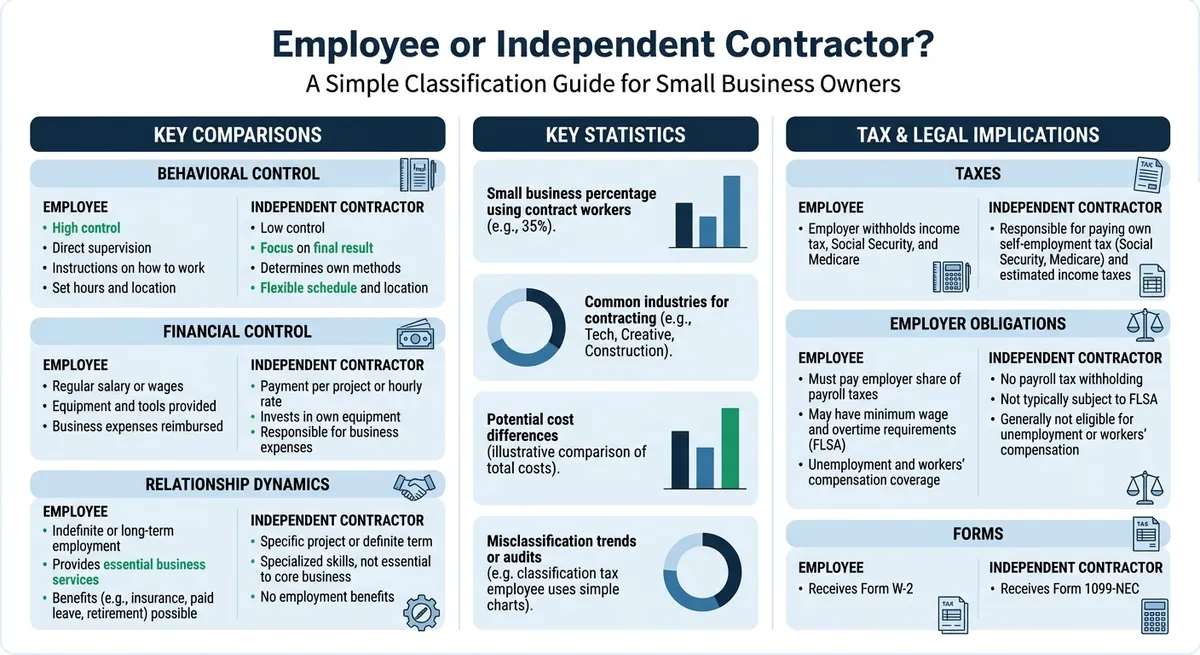
Key data and insights: Employee or Independent Contractor? A Simple Classification Guide for Small Business Owners
The IRS Worker Classification Test Explained
The IRS doesn't use a single yes-or-no test. It looks at the whole relationship between a business and a worker. Every fact matters, but no one fact decides the outcome on its own.
The agency groups its evidence into three categories: behavioral control, financial control, and the relationship of the parties[4]. Older 20-factor checklists still show up online. They can help you organize evidence, but they aren't used as a standalone legal test anymore; the underlying factors were largely folded into these three modern categories rather than formally withdrawn[3].
Behavioral Control: Who Directs the Work?
Behavioral control looks at who decides when, where, and how work gets done[9]. Training matters too. So does close supervision or a required process for approving each step.
If you set the schedule, provide the tools, and train someone on your exact methods, that points to employee status. Contractors usually figure out their own process. They don't need step-by-step direction to get the job done.
Financial Control: Who Bears Business Risk?
Financial control asks who carries the financial risk in the work. Think about unreimbursed expenses, real investment in equipment, and whether the worker can lose money or profit from the job.
Contractors typically set their own rates. They buy their own tools and take on other clients at the same time[7]. They also decide how to finish the assignment, not just when. No single financial detail settles the question by itself.
Relationship of the Parties: What Do the Documents and Facts Show?
This category covers contracts, benefits, and how long the relationship is meant to last. An open-ended relationship with paid benefits tends to look like employment.
A contract that calls someone a contractor won't override the facts on the ground[4]. If the work is central to your business and ongoing, that also weighs toward employee status. Once you settle on a classification, mark your calendar for 1099 filing deadlines so paperwork doesn't slip through the cracks.
How the Department of Labor and States May Classify Workers
The IRS isn't the only agency that cares how you classify workers. The Department of Labor and most states run their own tests too. Each one asks different questions and protects different rights.

| Test | Purpose | Key Factors | Agency | Obligations Affected |
|---|---|---|---|---|
| IRS Three-Category Test | Determines tax withholding duties | Behavioral control, financial control, relationship type | Internal Revenue Service | Payroll taxes, 1099 vs. W-2 reporting |
| DOL Economic Reality Test | Determines wage and overtime rights | Six factors tied to economic dependence | U.S. Department of Labor | Minimum wage, overtime pay |
| State ABC Test | Determines employee status under state law | Control, nature of work, independent trade | State labor agencies | Unemployment insurance, workers' comp, benefits |
Each test serves a different goal. A worker can pass one test and fail another, which confuses many small business owners.
The DOL Economic Reality Factors
In 2024, the DOL finalized a rule bringing back a six-factor economic reality test[14]. This test looks at whether a worker truly depends on the business for income or runs their own operation[15].
The six factors include opportunity for profit or loss, investments made by both the worker and the business, and how permanent the work relationship is. It also weighs control over the job, whether the work is central to the business, and the worker's skill and initiative[14]. Unlike the IRS approach, the DOL cares less about paperwork and more about real-world dependence. Getting this wrong can quickly turn into a payroll problem, which is where working with payroll compliance services can save you from costly overtime claims.
Why Federal Tests Can Produce Different Results
IRS rules, DOL rules, and state laws all exist for different reasons[5]. One law covers taxes. Another covers wages. A third covers benefits.
A worker might be a contractor for tax purposes but still qualify as an employee under wage law. That mismatch causes real headaches for owners who assume one test settles everything[10]. Document your reasoning separately for taxes, wages, benefits, and state rules.
State ABC Tests and Local Requirements
Many states use an ABC test instead of, or alongside, federal rules. It asks if the worker is free from control, does work outside the company's normal business, and runs an independent trade[5].
States like California apply strict versions of this test, but not every state follows the same script. Always check the rules where the work happens, and loop in an employment professional when the tests conflict.
A Practical Classification Checklist for Small Business Owners
Before you sign a contract or issue a first payment, run through this self-audit. It's a screening tool to help you spot risk early. It is not legal advice, and it won't replace a review from an attorney or tax professional.
> Review worker classification before making the first payment, rather than waiting for an audit or dispute.
Ask Who Controls the Details
Start with control. Who sets the schedule? Who picks the work location, the tools, and the methods used to finish the job?
If you train the worker, supervise daily tasks, or require approval before work moves forward, that points toward employee status[9]. Controlling the final result is normal in any contract. Controlling how someone gets there is different[11]. Write down both the contract terms and what actually happens day to day. Gaps between the two often cause trouble later.
Review Independence, Investment, and Business Opportunity
Next, look at how independent the worker really is. Do they advertise their services? Do they work with other clients besides you[8]?
Check for business insurance, owned equipment, and the ability to hire helpers. A true contractor can also profit or lose money based on how they price and manage a job[3]. Good records matter here too. Learning contractor bookkeeping basics can help you track project costs and keep clean documentation for each worker. Don't assume an LLC, a business license, or an invoice settles the question. None of those alone prove contractor status[7].
Evaluate Permanence and the Role in Your Business
Finally, think about time and role. Is this a short project, or does it run indefinitely? Continuous, open-ended work looks more like employment.
Ask whether the work sits at the core of your business. A bakery hiring a full-time baker is a clear example. A retail shop hiring a freelance web designer is not.
Build a documented fact pattern for each worker before you onboard them or renew their contract. Catching red flags early beats fixing them after an audit letter arrives.
Tax Forms, Payroll Records, and Ongoing Compliance
Classifying a worker is just the start. Once you decide, you need systems to back it up all year long. Here's a simple compliance timeline to follow.

- Onboarding: Collect Form W-4 from employees or Form W-9 from contractors before the first payment.
- Monthly bookkeeping: Track wages, withholding, and contractor payments as they happen.
- Year-end gathering: Confirm names, addresses, and tax ID numbers before forms go out.
- 1099 preparation: Review payment totals against current IRS thresholds for contractor reporting rules, keeping in mind the reporting threshold is set to rise from $600 to $2,000 starting in 2026 and then be indexed for inflation [1].
- Payroll filings: Submit W-2s and payroll tax deposits on time.
- Record retention: Keep files for at least three years, and up to four years for employment tax records, in case of an audit.
Always check current-year IRS guidance before you file anything. Rules can shift from year to year.
Employee Payroll Responsibilities
Employees fill out Form W-4 so you know how much tax to withhold. You'll also handle employer payroll taxes, wage records, and Form W-2 at year-end[4].
Employee status changes more than tax forms. It affects payroll frequency, overtime tracking, paid leave, and benefits, depending on the laws that apply to your business[6]. Don't wait until December to sort this out. Reconcile payroll records every month, not once a year, and lean on financial reporting support if the numbers feel messy.
Contractor Documentation and Form 1099-NEC
Form W-9 gives you a contractor's legal name and taxpayer ID before you pay them a dime. Get this signed early. It saves headaches later.
Most businesses must issue Form 1099-NEC when payments reach $600 in a year for 2024 and 2025, but that threshold is scheduled to rise to $2,000 starting with payments made in 2026 and will then be adjusted annually for inflation, so you should always confirm the latest IRS instructions before assuming the rule applies[10]. Payment type, entity status, and exceptions all matter here. A quick review of financial reporting support options can help you catch mistakes before they become bigger problems.
Build a Recordkeeping System That Supports Your Decision
Keep contracts, invoices, scopes of work, insurance certificates, and business registrations in one place. Add classification notes explaining why you made the call you did.
Track payments by vendor and reconcile 1099 totals before you file. Organized records often reveal patterns, like repeated control or ongoing work, that signal it's time to revisit a worker's status.
What to Do When Classification Is Unclear or Wrong
Sometimes a working relationship doesn't fit neatly into one box. When that happens, don't guess. Work through a clear process instead.
- Gather the facts about how the work actually happens day to day
- Compare those facts against IRS and state tests
- Check your specific state's classification rules
- Get advice from a tax pro or employment attorney
- Fix payroll and tax records if a mistake shows up
- Set up ongoing checks so this doesn't happen again
Classification mistakes can carry legal and tax consequences. This section offers general guidance, not legal advice. Talk to a qualified professional before making changes.
Common Red Flags of Misclassification
Some patterns almost always point to an employee relationship, even if the worker has a 1099. Watch for fixed schedules, detailed step-by-step instructions, and required training sessions[1]. Using company tools, getting ongoing supervision, or working exclusively for one business are also warning signs[6].
Paying by invoice, signing a contractor agreement, or filing a 1099 does not fix an employee relationship. The IRS looks at the real working conditions, not the paperwork[4]. If the arrangement shifts over time, say a contractor starts working set hours only for you, review the classification again right away.
Corrective Steps for a Past Classification Mistake
First, pause and document what actually happened. Don't delete or rewrite old records; you'll need an accurate history to fix things properly. This is also a good moment to revisit your business compliance checklist to catch other gaps.
Next, bring in a tax professional and an employment attorney. They can sort out payroll tax corrections, back wages, benefits exposure, and state-specific rules. Depending on the facts, they may discuss amended filings, back payments, or voluntary correction programs. Every case is different, so don't assume one fix applies to your situation.
When to Request an IRS Determination
If you genuinely can't tell how a worker should be classified, Form SS-8 lets you ask the IRS directly. The agency will review the facts and issue a federal determination. The IRS states this process can take at least six months, and it won't cover Department of Labor or state-level rules on its own[15]. Because the worker and business may have different interests here, get professional advice before you file.
Conclusion: Make Classification a Deliberate Business Decision
Worker classification is not a paperwork formality. It affects taxes, benefits, and legal risk. Treat it that way, and you'll avoid many problems small businesses run into.
Use the Facts, Not the Label
A written contract calling someone a contractor doesn't settle anything. What matters is the real relationship: who controls the work, who bears the financial risk, and how long the work is expected to last[4].
The IRS focuses on behavioral and financial control plus the type of relationship. The Department of Labor uses its own six-factor economic reality test under the FLSA[15]. States often add their own rules on top of both.
Because these tests don't always line up, you can't rely on just one agency's checklist. Check your payroll setup against all three angles before you assume you're covered.
Create a Repeatable Compliance Process
Classification isn't a one-time task. Review it whenever you onboard a new worker, change someone's job scope, renew a contract, or prep annual taxes[1]. A role that started as project-based contract work can quietly turn into an employee relationship over time.
Build a simple habit: check classification at each of those checkpoints, not just when a worker starts. Keep clean records for payroll, contracts, invoices, and 1099s so you can prove your reasoning if anyone asks. Good financial reporting makes this much easier, since it keeps contractor payments and employee wages clearly separated from day one.
- Review classification at hire, scope change, contract renewal, and tax season
- Keep signed contracts and job descriptions on file for every contractor
- Track 1099 and W-2 records separately and consistently
- Ask a professional when a role feels borderline
Getting this right protects your business and your workers. If you're not sure where your team stands, don't guess.
Need help sorting out payroll, contractor records, and 1099 reporting? Tidy Ledgers Bookkeeping can organize your financial reporting and keep your classification records audit-ready. Contact Tidy Ledgers Bookkeeping today to get started.
Frequently Asked Questions
Can I classify a worker as an independent contractor if they sign a contractor agreement?
A signed contractor agreement helps, but it’s not the final word. The IRS and Department of Labor look past the paperwork to how the work actually happens. They check behavioral control (who directs the day-to-day tasks), financial control (who covers expenses and risks profit or loss), and the nature of the relationship, including how permanent it feels. If the real working relationship looks like employment, a contract won’t change the legal outcome.
What happens if I accidentally misclassify an employee as a contractor?
Even honest mistakes can get expensive. You may owe back payroll taxes, penalties, and interest, plus possibly back wages or unpaid benefits under state or federal law. Some states add their own fines on top of federal ones, so the bill can stack up fast.
If you spot a possible misclassification, keep every record you have and talk to a tax professional or employment attorney right away. Acting quickly can reduce penalties and preserve options you might lose by waiting.
Do independent contractors always receive a Form 1099-NEC?
No, not automatically. It depends on how much you paid, what the payment was for, and who the contractor is. Payments to most corporations, for example, are often exempt, and there’s a dollar threshold below which reporting isn’t required, currently $600, though that reportedly rises to $2,000 starting in 2026 and is adjusted for inflation after that. The safest move is to collect a Form W-9 from every contractor before they start work, then check the current IRS threshold and filing deadline each year because the rules can change.
Conclusion
Getting worker classification right isn’t about what you call someone or how you pay them. It comes down to the real working relationship you have with them. The IRS looks at behavioral control, financial control, and how the two of you interact day to day. The DOL adds its own economic reality test for wage-and-hour rules, and your state may have even stricter standards.
Get it wrong, and you’re looking at back taxes, penalties, unpaid wages, and a pile of corrective paperwork. That’s a costly mistake for any small business.
Keep clean payroll and contractor records so you can support your decisions if questions come up. Take time now to review your current worker arrangements. Then reach out to Tidy Ledgers Bookkeeping. We’ll help you handle payroll compliance, contractor bookkeeping, 1099 reporting, and financial records.
Related Articles
- GuideWho Needs A 1099-NEC: Contractor Rules for This YearLearn who needs a 1099-NEC, key payment thresholds, exceptions, and deadlines. Get contractor reporting right-review the rules and prepare before year-end.Read the guide
- Guide1099 Deadlines for Small Businesses: What to File and When1099 deadlines for small businesses made simple: learn 1099-NEC and 1099-MISC due dates, e-filing rules, and tips to avoid penalties. Read now!Read the guide
- PayrollAccurate payroll with Idaho withholding, unemployment, and W-2 / 1099 filings handled for you
- GuideBookkeeping for Contractors: Tracking Job Costs, Materials, and Subcontractor PaymentsBookkeeping for contractors made easier: track job costs, materials, subcontractor payments, retainage, and 1099s to protect margins. Learn how today!Read the guide
- GuideStarting a business in Idaho: a bookkeeping and compliance checklistA practical checklist for new Idaho business owners, from registering with the Secretary of State to setting up clean books before your first sale.Read the guide
- GuideIdaho sales and use tax: a plain guide for small businessesIdaho's sales and use tax is 6%, but the rules around permits, filing schedules, use tax, and resort-city add-ons trip up plenty of good owners. Here's how it works.Read the guide
Common questions
Can I classify a worker as an independent contractor if they sign a contractor agreement?
A signed contractor agreement helps, but it's not the final word. The IRS and Department of Labor look past the paperwork to how the work actually happens. They check behavioral control (who directs the day-to-day tasks), financial control (who covers expenses and risks profit or loss), and the nature of the relationship, including how permanent it feels. If the real working relationship looks like employment, a contract won't change the legal outcome.
What happens if I accidentally misclassify an employee as a contractor?
Even honest mistakes can get expensive. You may owe back payroll taxes, penalties, and interest, plus possibly back wages or unpaid benefits under state or federal law. Some states add their own fines on top of federal ones, so the bill can stack up fast. If you spot a possible misclassification, keep every record you have and talk to a tax professional or employment attorney right away. Acting quickly often reduces penalties and gives you options you'd lose by waiting.
Do independent contractors always receive a Form 1099-NEC?
No, not automatically. It depends on how much you paid, what the payment was for, and who the contractor is. Payments to most corporations, for example, are often exempt, and there's a dollar threshold below which reporting isn't required. The safest move is to collect a Form W-9 from every contractor before they start work, then check the current IRS threshold and filing deadline each year since rules can shift.

Want this handled for you?
Get a free, no-obligation quote and a quick health check of where your books stand. We reply within one business day. No pitch, no pressure.