
Guide
How to Fix the 5 Most Common Bookkeeping Mistakes Small Businesses Make
Updated October 13, 2026

Key Takeaways
- Separate business and personal transactions, then correctly record owner contributions and withdrawals.
- Review expense categories and reconcile bank and credit card accounts every month.
- Keep supporting documents according to the retention rules for each record type.
- Track unpaid invoices and bills. Under accrual accounting, record them when the invoice or bill arrives. Under cash-basis accounting, record income and expenses when money moves. Also address bookkeeping backlogs before they grow.
A healthy bank balance can fool you. Behind that number, your books might hide unpaid bills, overdue invoices, or expense totals you can't trust. It happens to plenty of careful owners.
If you handle your own bookkeeping or oversee a small admin team, we'll cover five common mistakes that small businesses often report. This is not a ranked list of the five most common errors. For each one, you'll learn how to spot it, fix it, and keep it from coming back.
No blame here. Most of these slip in when you're busy running the business. If your records need a deeper cleanup, Tidy Ledgers Bookkeeping is one resource worth a look. Disclosure: Tidy Ledgers Bookkeeping provides the cleanup service mentioned in this article, and the resource links below point to its site.
Mistake 1: Mixing Business and Personal Finances
This mistake starts small. You grab groceries on the business card. You pay a supplier from your personal checking account. Soon your books can't tell you what the business actually earns.[1]
Spot Personal Transactions Hiding in Your Business Books
Look for three red flags. Personal purchases show up on business cards. Business costs get paid from personal accounts. Transfers between the two get logged as income or expenses.
Mixed transactions slow and complicate reconciliations, hide how the business is doing, and weaken the paper trail behind your deductions. The IRS expects records that support every item you report.[4]
Until you separate personal and business transactions, you can't verify the rest of the books.[2]
Separate Accounts and Correct Existing Transactions
The fix starts with separating business and personal finances. Open a dedicated business checking account. Add a business card or another payment method too, if the account terms and your needs allow it.
Then clean up the past. Don't delete odd entries without checking them first. Keep the originals, add notes, and fix the classification so a clear trail remains. If you confirm an entry is a true duplicate, void or delete it and leave a note explaining why.
Owner money needs special care. Contributions, draws, reimbursements, and distributions are not automatically income or deductible expenses. How you record them depends on your entity type, so confirm the right treatment with your accountant.
Use this quick checklist to get started:
- Open a business bank account and route all business income and costs through it.
- Flag every personal item in your business books.
- Write down the business purpose for anything unclear.
- Reclassify entries as owner draws, contributions, or reimbursements as appropriate.
- Save receipts and statements that support each correction.
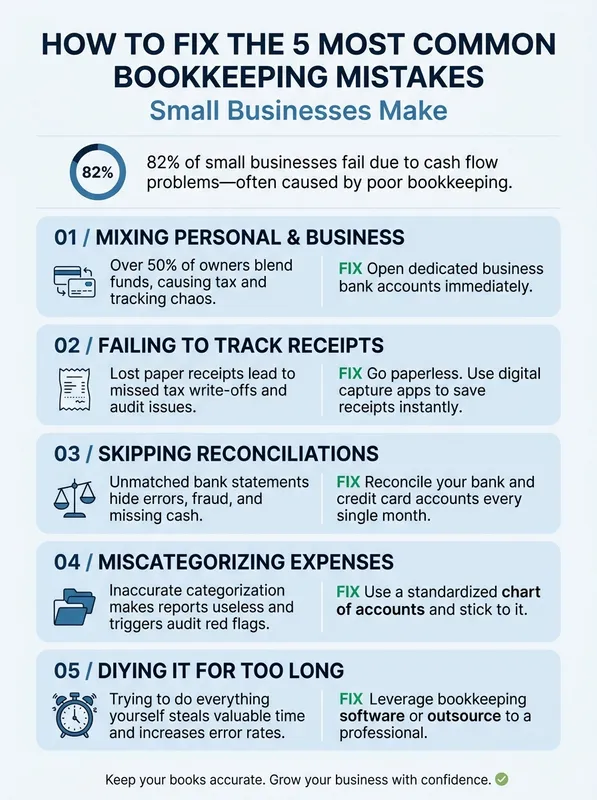
Key data and insights: How to Fix the 5 Most Common Bookkeeping Mistakes Small Businesses Make
Mistake 2: Miscategorizing Expenses and Transactions
Misclassified transactions can distort your reports even when the profit-and-loss statement looks fine[2].
Find Categories That Distort Your Financial Reports
Start with the warning signs. Look for a large miscellaneous balance, the same vendor sitting in different categories, and transfers booked as revenue. Moving money between your own accounts isn't income.
Classify each transaction by what it represents. Operating expenses, asset purchases, loan principal, owner transactions, and credit card payments each need different treatment[3]. The right treatment depends on the transaction's purpose, your accounting method, your entity structure, and the tax rules that apply to you. No single answer fits every business.
Shifting categories make it hard to compare months or years.
| Transaction | Common incorrect treatment | Correct treatment to investigate | Supporting document |
|---|---|---|---|
| Transfer between business accounts | Recorded as income or expense | Record as a transfer between balance sheet accounts | Bank statements for both accounts |
| Loan payment | Whole payment booked as expense | Split principal (reduces the loan) from interest (an expense) | Loan statement or amortization schedule |
| Credit card payment | Booked as an expense, double-counting purchases | Treat as a payment toward a liability; categorize the underlying charges | Card statement and receipts |
| Equipment purchase | Automatically expensed | Review whether to capitalize the purchase or whether expensing is permitted | Invoice and proof of payment |
Repair Categories and Review Bank Feed Rules
Use invoices, receipts, and loan statements to verify what each payment covered[1]. Then apply one consistent chart of accounts across the whole year.
- Review every automated categorization rule before you allow broad automation.
- Match imported bank transactions to existing entries instead of adding duplicates.
- Keep supporting records for each corrected entry[4].
- Send uncertain asset, financing, or tax questions to a qualified bookkeeper or tax professional.
Duplicates often start in the bank feed, so check there first. Our guide to fixing common QuickBooks Online errors walks you through the usual culprits.
Mistake 3: Skipping Monthly Account Reconciliation
Understand Why Bank Feeds Are Not Reconciliation
Reconciliation means comparing your recorded transactions and balances with an account statement. A connected bank feed doesn't replace reconciliation. Feeds can miss transactions, create duplicates, or match items to the wrong category[1].
Watch for these warning signs:
- A balance difference you can't explain
- Missing bank fees or interest
- Outstanding checks or deposits that sit for months
- An opening balance that doesn't match last month's closing balance
Routine reconciliation catches errors before they grow[3]. Small mistakes are easy to fix in the month they happen. They're painful a year later.
Reconcile Accounts Without Forcing the Difference
Reconcile each bank and credit card account every month. Use this workflow:
- Pull the statement for the period. Note the opening and closing balances.
- Confirm your opening balance matches the prior reconciled period.
- Match each transaction in your books to the statement.
- Enter legitimate missing items, such as fees or interest.
- Investigate anything unmatched, including possible duplicates.
- Compare your adjusted book balance to the statement's closing balance.
Illustrative example: Say your books show a credit card balance $250 higher than the card statement does. You scan the card transactions and find one purchase entered twice. (On a bank account, a duplicated expense would work the other way. Your books would show less cash than the bank.) Verify the duplicate against the statement first. Then void or delete the extra entry, and add a note explaining why.
Timing differences are normal. A check you wrote on the 30th may not clear until next month, and that outstanding item needs no adjustment[2].
Never post an unsupported adjustment just to force a zero difference. It hides the real problem. If several months are behind, work chronologically from the oldest period. Also review how any change affects periods you already reconciled.
Make this part of your month-end bookkeeping checklist so it never gets skipped.
Mistake 4: Losing Receipts and Supporting Records
A ledger entry without proof behind it is just a claim. If the IRS asks, you need documents that back up what you reported.

Rebuild the Documentation Behind Your Transactions
The IRS says you must keep records that support income, deductions, and credits on your return. Except in a few cases, it doesn't require one specific bookkeeping system. It just wants records that clearly show your numbers.
A bank statement proves you paid someone. It doesn't prove what you bought or why. You also need the invoice or receipt, plus a note on the business purpose when it isn't obvious.
To fill gaps, check vendor portals, email inboxes, and payment platforms like PayPal or Stripe. Ask suppliers to reissue old invoices. If something stays missing, flag it. Never invent a receipt.
Name files the same way every time, such as date, vendor, and amount. Attach each document to its accounting entry when your software allows it. Our catch-up bookkeeping checklist walks you through this cleanup step by step.
Apply Retention Rules Instead of a Blanket Three-Year Rule
There's no single deadline for tossing records. How long you keep something depends on the record type and its limitations period, as IRS Publication 583 explains.[4] Practical guides like the U.S. Chamber of Commerce retention guide summarize the IRS timelines for small businesses and point out which records to keep permanently.
| Record or circumstance | Federal retention baseline | Important qualification |
|---|---|---|
| General tax support | 3 years from the date you file (the usual period for IRS assessment of tax you owe) | For refund or credit claims, the period is the later of 3 years from filing or 2 years from payment. For these purposes, a return filed before the due date (without regard to extensions) is treated as filed on the due date. A return filed after the due date under an extension is treated as filed when it is received. |
| Omitted gross income over 25% of reported gross income | 6 years | Applies to substantial omissions only |
| Employment tax records | At least 4 years after the tax is due or paid, whichever is later | Covers payroll and withholding documents |
| Property records | Through the limitations period for the return covering disposition | Keep them until you sell or otherwise dispose of the asset in a taxable disposition, then add the period |
| Fraudulent return or no return filed | Indefinitely | No limitations period starts running |
These are federal baselines, not individualized legal or tax advice. State rules, contracts, lenders, and insurers may require longer retention.
Back up everything securely, and limit who can access financial files. Before you shred anything, check the current IRS guidance. A quick check costs far less than a missing record.
Mistake 5: Letting Unpaid Invoices and Bills Go Unchecked
Unpaid invoices and unpaid bills quietly distort your numbers. If you don't track them, your cash picture is a guess. This mistake appears on many lists of common bookkeeping errors[2].

Identify Stale Receivables and Unrecorded Payables
Accounts receivable is money customers owe you. Accounts payable is money you owe vendors. Under accrual accounting, both need to be recorded when the invoice or bill arrives, not when cash moves. Under cash-basis accounting, income and expenses are recorded when money is received or paid instead.
Missing invoices, unmatched customer payments, duplicate bills, and forgotten vendor obligations all make cash planning unreliable[1]. Run an aging report for both sides. Then sort what you find before you chase anyone, because an "overdue" balance may just be an unapplied payment, a credit, or a duplicate entry.
Use this aging-review checklist:
- Current: Confirm the invoice or bill is recorded and the due date is on your calendar.
- 1-30 days overdue: Check for unapplied payments, then send a friendly reminder or schedule the payment.
- 31-60 days overdue: Verify the balance with the customer or vendor and look for disputes or errors.
- 61-90 days overdue: Review the account history, confirm what's still owed, and decide on a next step.
- More than 90 days overdue: Confirm the balance is real before you escalate, adjust, or write anything off.
Correct Open Balances and Establish a Follow-Up Routine
Start by matching each customer payment to its invoice and each vendor payment to its bill. Apply credits only when you have paperwork to support them[3]. Our guide to reconciling accounts payable and receivable walks through this at month end.
Confirm any disputed or stale balance before you act. Don't write it off, escalate it, or schedule payment until you know it's accurate. The goal here is clean balances and clear cash visibility, not pressure tactics.
Then prevent new backlogs. State payment terms on every invoice, send reminders on a set schedule, and keep a due-date calendar for bills.
One more trap: paying a bill is not the same as recording the expense. Under accrual accounting, you record the expense when the bill arrives. Paying it later just clears the payable.
Under cash accounting, you record it when you pay. Either way, count each transaction once.
Build a Routine That Keeps Bookkeeping Mistakes From Returning
Fixing old errors only helps if new ones don't pile up. A short, repeatable routine does that. It turns bookkeeping from a once-a-year scramble into a habit.
Set a Simple Weekly and Monthly Review Schedule
Pick a fixed day and put it on the calendar. Name one person who owns each task, and give them a deadline. A routine that depends on spare time won't last. Your records need to show income and expenses clearly[4], and software automation doesn't replace a human review[1].
Consistency matters more than perfection. Some small business bookkeeping guidance stresses that timely entries help prevent the backlog that causes many errors[3]. As an editorial paraphrase (not a sourced quote): a few focused minutes each week beat a full weekend of catch-up each quarter.
Weekly checklist:
- Capture receipts and documents from the week.
- Review new transactions and fix wrong categories.
- Send invoices for finished work.
- Check bills coming due so nothing is paid late.
Monthly checklist:
- Reconcile bank and card accounts to your statements.
- Clear out uncategorized activity.
- Review receivable and payable aging for overdue items.
- Read your financial reports and look into any unusual swings.
Commonly cited mistakes, like skipped reconciliations and mixed accounts, show up fast when you review on schedule[1][2].
Know When Professional Bookkeeping Cleanup Makes Sense
Some problems are too big for a weekly routine. Watch for these signs:
- Several months of unreconciled accounts.
- Opening balances you can't explain.
- Duplicates that keep coming back.
- Reports you no longer trust.
If that sounds familiar, professional bookkeeping cleanup can get you back to a clean starting point. Come prepared. Gather account statements, give access to your accounting file, collect supporting documents, and list the problems you already know about.
Keep one line clear. Cleanup fixes your books. It isn't tax advice. For amended returns, tax treatment questions, or payroll-tax concerns, talk to a qualified tax professional.
Frequently Asked Questions
Can I fix bookkeeping mistakes myself?
Often, yes, if the mistake is small and well documented. A single miscategorized expense or a verified duplicate entry is usually a safe DIY fix, as long as you understand the correction and keep an audit trail, such as a note or a journal entry that shows what changed and why. Get a professional involved if errors are widespread, affect prior periods, involve classifications you're unsure about, or start from unreliable opening balances. If a fix could change a return you already filed, talk to a tax professional first.
How often should a small business reconcile its accounts?
Reconcile each bank and credit card account at least once a month. That's a practical habit, not a rule set by the IRS. If you process a lot of transactions, weekly or even more frequent reviews can catch problems sooner.
Glancing at your bank feed or current balance doesn't count. Reconciliation means matching every entry in your books to your statement and resolving the differences.
How long should I keep business receipts and tax records?
The general baseline is 3 years from the date you file your return. That is the usual period the IRS has to assess tax you owe. Refund claims follow a slightly different rule: the later of 3 years from filing or 2 years from payment.
But that's not a one-size-fits-all deadline. The period stretches to 6 years if you omitted more than 25% of the gross income shown on your return.
Employment tax records should be kept at least 4 years, and property records should be kept until the limitations period ends for the year you dispose of the asset. Check the retention table in IRS Publication 583 and the current IRS guidance, and don't apply one deadline to every record.
Start With One Bookkeeping Fix This Week
Clean books come from five habits: separate finances, steady categories, reconciled accounts, saved records, and tracked invoices and bills. You don't need to fix everything at once. Pick one task and finish it.
- Fix your most urgent discrepancy first.
- Save the receipts and statements that back it up.
- Set a recurring monthly review.
If a backlog or unexplained balances stall you, explore Tidy Ledgers Bookkeeping's catch-up and cleanup service through the link above. Help like this clears the mess, but it's not personal tax advice.
Related Articles
- 10 Common QuickBooks Online Errors and How to Fix ThemMost QuickBooks Online errors involve bank feeds, duplicate transactions, payroll connections, user access, or reconciliation discrepancies.
- Separating Business and Personal Finances: Fix the MixLearn how to separate business and personal finances, correct commingled transactions, and build a clean monthly bookkeeping routine.
- Month-End Bookkeeping Checklist for Small BusinessesA practical monthly routine for reconciling accounts, reviewing financial reports, documenting open items, and closing cleaner books.
- How to Clean Up Old Uncleared Transactions in QuickBooks OnlineAn uncleared transaction is a reconciliation status, not proof that an entry is wrong. This guide helps owners investigate stale QuickBooks Online items, choose a supported next step, and protect reconciled or filed periods.
- How to Reconcile Accounts Payable and Receivable at Month-EndLearn how to reconcile accounts payable and receivable at month-end, resolve discrepancies, document controls, and close books accurately.
- Behind on Your Books? A Catch-Up Bookkeeping ChecklistA calm, step-by-step checklist for business owners who are behind on their books, covering statements, reconciliation, categories, sales tax, payroll, and getting tax-ready.
Common questions
Can I fix bookkeeping mistakes myself?
Often, yes, if the mistake is small and well documented. A single miscategorized expense or a duplicate entry is usually a safe DIY fix, as long as you understand the correction and keep an audit trail, such as a note or a journal entry that shows what changed and why. Get a professional involved if errors are widespread, affect prior periods, involve classifications you're unsure about, or start from unreliable opening balances. If a fix could change a return you already filed, talk to a tax professional first.
How often should a small business reconcile its accounts?
Reconcile each bank and credit card account at least once a month. That's a practical habit, not a rule set by the IRS. If you process a lot of transactions, weekly or even more frequent reviews can catch problems sooner. Glancing at your bank feed or current balance doesn't count. Reconciliation means matching every entry in your books to your statement and resolving the differences.
How long should I keep business receipts and tax records?
The general baseline is 3 years from the date you file your return. But that's not a one-size-fits-all deadline. The period stretches to about 6 years if you underreported income by more than 25%. Employment tax records should be kept at least 4 years, and property records should be kept until the limitations period ends for the year you dispose of the asset. Check the retention table in IRS Publication 583 and the current IRS guidance, and don't apply one deadline to every record.

Want this handled for you?
Get a free, no-obligation quote and a quick health check of where your books stand. We reply within one business day. No pitch, no pressure.