
Guide
How to Read a Balance Sheet: A Small Business Owner's Guide
Updated September 8, 2026

Key Takeaways
- A balance sheet shows your business's assets, liabilities, and owner's equity at a specific point in time.
- The accounting equation-assets = liabilities + equity-must always balance.
- Current ratio, debt-to-equity, and working capital reveal liquidity, financial risk, and operating flexibility.
- Comparing balance sheets over time helps identify cash flow problems, debt growth, and opportunities to improve profitability.
A balance sheet turns a confusing pile of numbers into a picture of whether your business is financially stable. That matters when cash is tight or you're asking a bank for a loan. Owners who skip this report can miss warning signs until it's too late.
An income statement tracks activity over weeks or months. A balance sheet is a snapshot of where your business stands on one specific day.
Every balance sheet rests on three parts: assets, liabilities, and equity. This guide explains what each one means and how to read them together.
What Is a Balance Sheet?
A balance sheet is one of three core financial reports every small business owner should know. It shows a snapshot of your business at one exact moment[1]. The other two reports, the income statement and cash flow statement, cover a stretch of time instead.

Together, these three reports show how your business is doing. Here's how they compare:
| Statement | Reporting Period | Primary Purpose | Questions It Answers |
|---|---|---|---|
| Balance Sheet | A specific date | Shows what you own, owe, and have invested | What is my business worth right now? Can I cover my debts? |
| Income Statement | A set period (month, quarter, year) | Tracks revenue and expenses over time | Did I make a profit? Are sales growing? |
| Cash Flow Statement | A set period | Tracks cash moving in and out | Do I have enough cash to pay bills? |
The Purpose of a Balance Sheet
A balance sheet lists what your business owns, what it owes, and what's left over for you as the owner[2]. Owners use it to check financial health. Lenders and investors use it to judge risk before handing over money.
Tax professionals rely on it too, especially at year-end. Think of it as one piece of a bigger puzzle. It works best alongside your income statement and cash flow report, not instead of them[3].
The Accounting Equation Explained
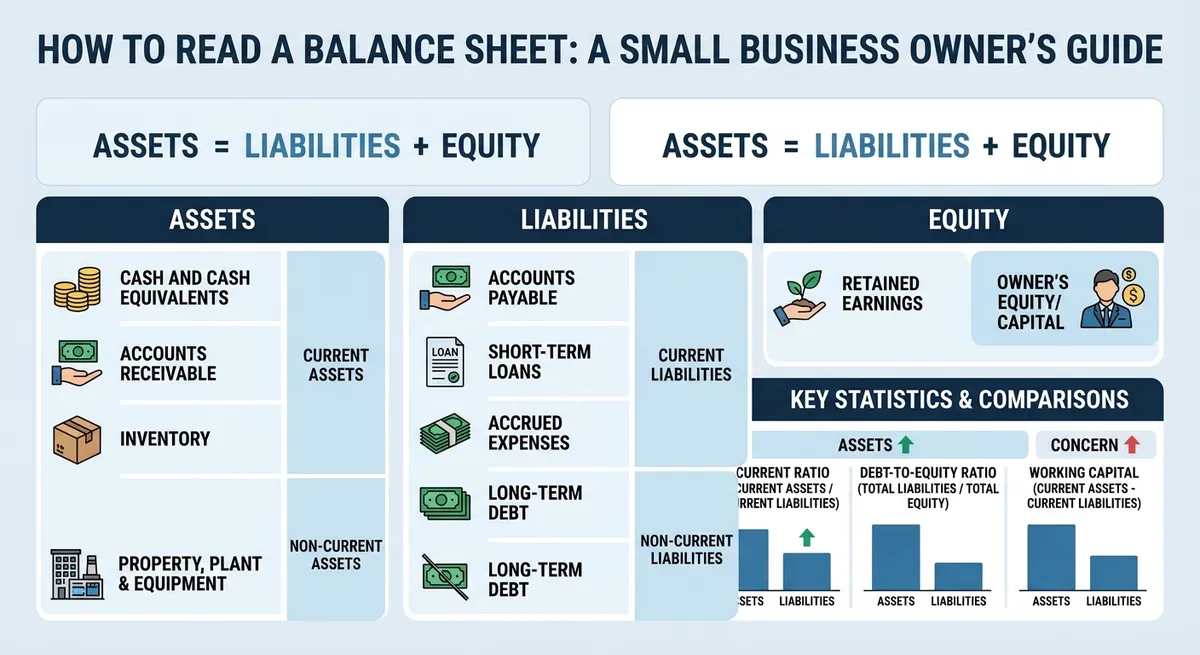
Every balance sheet follows one simple rule: assets equal liabilities plus owner's equity. This is the accounting equation, and it must balance. If it doesn't, something's wrong in your books.
Say you buy a $10,000 piece of equipment using a business loan. Your assets go up by $10,000. Your liabilities also go up by $10,000. The equation still balances because the transaction affects at least two accounts.
Balance Sheet Versus Income Statement
The balance sheet captures one moment. The income statement covers a whole period, like a month or a year[15]. That's why a business can show a profit on paper and still run short on cash.
You might sell a lot of product but still be waiting on unpaid invoices. That's a cash problem, not a profit problem. Reviewing both statements side by side, and keeping up with your month-end bookkeeping checklist, gives you a clearer view of where your business stands.
Key data and insights: How to Read a Balance Sheet: A Small Business Owner's Guide
Understand the Three Parts of a Balance Sheet
Every balance sheet has three sections: assets, liabilities, and equity. Once you know how they connect, the report gets easier to read[2].
Assets: What Your Business Owns
Assets are things your business owns that bring future value. This includes cash, equipment, and anything else that helps the business run or grow[5].
Current assets are items you can turn into cash within a year. Think cash, accounts receivable, inventory, and prepaid expenses. Long-term assets take longer to convert to cash. These include equipment, vehicles, property, and intangible assets like patents[3].
Assets are usually listed from most liquid to least liquid. Cash goes first, buildings go last. This order shows how much cash you can access quickly if you check your monthly financial statements regularly.
Liabilities: What Your Business Owes
Liabilities are debts and obligations your business owes to others, including lenders, vendors, employees, and tax agencies[6].
Current liabilities are due within about a year. Long-term liabilities stretch further out. Common examples include:
- Accounts payable and credit card balances
- Accrued expenses and payroll taxes owed
- Lines of credit and term loans
Rising liabilities aren't automatically a bad sign[4]. Debt can fund growth. The question is whether your assets and cash flow can cover what you owe.
Owner's Equity and Retained Earnings
Equity is what's left after you subtract liabilities from assets. It reflects the owner's stake in the business[2].
Owner contributions and withdrawals both affect this number, so clear records matter. Our guide to separating business and personal finances covers this in more depth. Profits grow equity over time, while losses and owner draws shrink it.
Equity looks different depending on your business type. Sole proprietors see owner's equity. Corporations show stock and retained earnings instead[5].
How to Read a Balance Sheet Step by Step
Reading a balance sheet means checking each section and asking what it means for cash flow. Trends often tell you more than single balances. A number that looks fine today can hide a problem that's been building for months.

Start With the Reporting Date and Accounting Basis
Before you read any figure, check the date at the top of the report. A balance sheet from three months ago won't tell you much about today's cash position[2].
Next, confirm whether the business uses cash-basis or accrual-basis accounting. This changes how receivables and payables show up and can shift reported income up or down[6]. Good financial reporting and insights depend on a clear, consistent accounting basis. Lastly, make sure the statement is reconciled against bank, credit card, loan, and inventory records before you trust it.
Review Assets for Liquidity and Quality
Assets aren't all equal. Cash is ready to use, but receivables and inventory take time to turn into cash[4]. Watch for overdue receivables and slow-moving inventory, since both can overstate what a business actually owns[12]. A big total asset number means little if most of it can't pay this month's bills.
Examine Liabilities and Equity Together
Look closely at what's coming due soon, including loans, interest payments, and unpaid taxes[5]. Compare total liabilities to equity to see how much of the business runs on borrowed money[14]. Then check whether equity is climbing because of steady profits or shrinking from losses and owner withdrawals.
| Review Step | What to Inspect | Warning Signs |
|---|---|---|
| Reporting date and basis | Statement date, cash vs. accrual method | Outdated report, unclear accounting method |
| Cash and equivalents | Bank balances, short-term reserves | Cash dropping steadily period over period |
| Accounts receivable aging | How long invoices have gone unpaid | Large balances past 60 or 90 days |
| Inventory | Quantity, age, turnover rate | Stock that isn't selling or is outdated |
| Accounts payable | Bills owed to vendors | Payables growing faster than sales |
| Current and long-term debt | Loan balances, interest terms, due dates | Rising debt with flat or falling revenue |
| Owner equity | Retained earnings, draws, contributions | Equity shrinking quarter after quarter |
| Prior period comparison | Trends across several statements | Sudden swings without a clear cause |
Key Balance Sheet Ratios for Small Businesses
Ratios turn raw numbers into signals. They help you spot trouble before it grows into a real problem[12]. Here are three formulas worth knowing, with simple examples.
- Working capital: $75,000 current assets minus $50,000 current liabilities = $25,000
- Current ratio: $75,000 current assets ÷ $50,000 current liabilities = 1.5
- Debt-to-equity ratio: $120,000 liabilities ÷ $80,000 equity = 1.5
These numbers are examples, not universal targets your business has to hit[13].
Current Ratio and Working Capital
Working capital is what's left after you pay off short-term debts with short-term assets. A positive number means you have breathing room. A negative one is a warning sign.
The current ratio compares current assets with current liabilities. Divide current assets by current liabilities to get it. Many small businesses aim for a ratio between 1.5 and 2, though this varies a lot by industry, retailers often run safely below 1.0 thanks to fast inventory turnover, while manufacturers and construction companies may need 2.0 or higher[14].
A ratio under 1 usually means trouble for most businesses, since it suggests you may struggle to pay bills as they come due, though some industries (like retail) can operate safely below that threshold. This is one more reason to separate business finances from personal accounts, so these numbers actually reflect your company's health.
Debt-to-Equity Ratio
This ratio compares what you owe to what you actually own. Divide total liabilities by owner's equity to find it. A high number means you rely heavily on borrowed money, which can worry lenders[9].
But lower isn't always better. A very low ratio might mean you're too cautious and missing growth chances. Compare your number to others in your industry, and track it over time to see the trend.
Other Useful Measures
The quick ratio is stricter than the current ratio. It leaves out inventory, since that can be slow to sell. This gives a more honest picture of short-term cash access[7].
It's also worth watching accounts receivable days, inventory turnover, and total liabilities as a share of assets. No single ratio tells the whole story. Focus on trends over time, not one perfect score.
Balance Sheet Red Flags to Watch For
Some warning signs show up fast. Others creep in over months. That's why a single balance sheet snapshot only tells part of the story.

> Industry guidance generally emphasizes reviewing balance-sheet trends over time rather than relying on a single snapshot.
Watching how numbers shift over time helps you catch problems before they turn into emergencies. Here are the three biggest red flags small business owners should track.
Not Enough Liquid Assets to Cover Bills
If your current liabilities are higher than your current assets, stop and look closer. This is one of the clearest signs of trouble on a balance sheet[4].
Slow customer payments are often the culprit. So is too much cash tied up in inventory sitting on shelves. Large owner withdrawals and rising credit card balances can drain liquidity too[6].
This isn't just a balance sheet issue. Cash flow struggles are common among small businesses, and many owners report ongoing difficulty covering short-term expenses[7]. Data from the Federal Reserve's small business survey backs this up: the 2024 Small Business Credit Survey found that 51% of firms cited uneven cash flows and 56% cited paying operating expenses as ongoing financial challenges, confirming cash flow gaps as a persistent problem for owners across industries[9].
Receivables, Inventory, or Fixed Assets Are Overstated
Not every invoice on your books will actually get paid. Some customers pay late. Others never pay at all. Inventory can lose value too, through damage, spoilage, or simply going out of style.
Equipment is tricky as well. Depreciation lowers the book value over time, but that number may not match what the equipment would actually sell for[8].
Check your numbers regularly. Review your accounts receivable aging report, count your inventory by hand, and look over your fixed-asset schedule. If your books have gotten messy or out of date, working through a catch-up bookkeeping checklist can help you fix stale reconciliations and misclassified transactions before they distort your asset values.
Debt and Owner Withdrawals Are Increasing
Watch what happens when debt keeps climbing but equity stays flat or drops. That combo often means the business isn't generating enough profit to fund its own growth[14].
Owner draws are normal. But there's a difference between planned distributions and personal expenses that got miscoded as business costs. Mixing the two makes your balance sheet unreliable.
Keep business and personal finances separate. Record every transaction correctly the first time. It's a small habit that saves a lot of headaches down the road.
How to Use Your Balance Sheet for Better Decisions
Reading your balance sheet is one thing. Using it to make smart calls is another. Here's a simple monthly routine to follow:
- Reconcile all bank and credit card accounts
- Verify receivables and payables are accurate and current
- Review debt balances and owner equity
- Calculate key ratios like working capital and debt-to-equity
- Compare this month to last month and last year
- Document any unusual changes and why they happened
- Assign follow-up actions to yourself or your bookkeeper
Once this becomes a habit, your monthly financial statements start to tell a clear story about your business.
Plan Cash Flow and Manage Working Capital
Your balance sheet shows what you have and what you owe. Use it to spot cash problems before they hit.
Look at your receivables, payables, inventory, and cash balance together. Slow-paying customers or a pile of unsold inventory can drain cash fast
Common Balance Sheet Mistakes and When to Get Help
Even a balance sheet that looks fine can hide real problems. Small errors add up fast. Here's what tends to go wrong, and when it's time to call in help.
Common Errors Small Business Owners Make
Mixing personal and business spending is one of the most common mistakes owners make[3]. It muddies your numbers and makes it hard to know what your business actually owns.
Other frequent issues include:
- Skipping account reconciliations for months at a time
- Misclassifying loans as income instead of liabilities
- Recording equipment purchases as expenses instead of assets
- Forgetting to record accrued liabilities, like unpaid wages or taxes owed
These mistakes throw off your equity, profit numbers, and tax filings[5]. They can also hurt your chances with lenders. A balance sheet can technically balance and still be wrong, since bad classifications cancel out on paper[6]. If your books have fallen behind, a catch-up bookkeeping checklist can help you fix outdated records before they cause bigger issues.
How Bookkeeping Support Improves Accuracy
A bookkeeper reconciles your accounts, tracks depreciation schedules, and codes transactions the right way. That work turns messy numbers into a report you can actually trust[12].
Timely monthly reports let you catch problems early, like a cash crunch or rising debt, before they become emergencies[1]. If you'd rather focus on running your business than untangling spreadsheets, reach out to Tidy Ledgers Bookkeeping for support that keeps your records accurate and easy to understand.
Questions to Ask Before Trusting the Numbers
Before you rely on your balance sheet, ask a few key questions. Are your bank, credit card, loan, and payroll balances reconciled? Do accounts receivable and accounts payable match what customers and vendors actually owe?
Check that fixed assets, depreciation, and owner contributions or distributions are recorded the same way each month[15]. Look for any unexplained jumps from one month to the next. If something doesn't add up, it may need a correcting entry or a second set of eyes.
Preparing for year-end review makes this easier. Our year-end bookkeeping checklist walks you through building complete, accurate financial records before tax season hits.
Frequently Asked Questions
How often should a small business owner review a balance sheet?
Review your balance sheet monthly, right after you reconcile your accounts. That keeps the numbers fresh and lets you catch problems early. You should also pull it up before borrowing money, hiring staff, buying big equipment, or taking a large owner draw. Oddly enough, many owners skip this step; anecdotally, bookkeeping professionals report that only a minority of small business owners check their balance sheet monthly, even though experts push for it.
What is a good current ratio for a small business?
Most accounting experts point to a current ratio of about 1.5 to 2 as a solid target for many businesses. That means you have $1.50 to $2 in current assets for every dollar of current liabilities. But the right number depends heavily on your industry: retailers often run safely below 1.0 due to fast inventory turnover, while construction companies may need 2.0 to 3.0 or more. Your ideal ratio also depends on how steady your revenue is, your payment terms, and how much inventory you carry, so don't treat 1.5 to 2 as a hard rule.
Why does my balance sheet balance if my business is short on cash?
A balance sheet always balances by design: assets equal liabilities plus equity, no matter what. But that total assets figure can include money customers owe you, inventory sitting on shelves, or equipment you own, none of which pays your bills today. That's the gap between accounting balance and real liquidity. If cash feels tight, check your current liabilities against your current assets and look closely at your cash flow, not just the balance sheet total.
Conclusion
A balance sheet is more than assets, liabilities, and equity lining up. It's a snapshot of how your business really works. Once you understand the accounting equation and key ratios like current ratio, debt-to-equity, and working capital, you can spot problems before they grow. You'll also see chances to improve cash flow and profit.
The real value comes from checking in regularly. Monthly reconciliations and reports turn your balance sheet into a tool you actually use, not just a document you file away. Comparing statements over time shows patterns: rising debt, shrinking cash, or steady growth.
Pull out your latest balance sheet and walk through the steps in this guide. If your books need cleanup or you want accurate monthly reporting, contact Tidy Ledgers Bookkeeping. We'll help you get numbers you can trust and use.
Related Articles
- Financial Reporting & InsightsClear monthly reports, AP/AR, 1099s, and KPIs that turn your numbers into confident decisions
- GuideMonth-End Bookkeeping Checklist for Small BusinessesA practical monthly routine for reconciling accounts, reviewing financial reports, documenting open items, and closing cleaner books.Read the guide
- Monthly BookkeepingCategorized transactions, reconciled accounts, and clean monthly financials, closed on time, every month
- Guide10 Common QuickBooks Online Errors and How to Fix ThemKey Takeaways Most QuickBooks Online errors involve bank feeds, duplicate transactions, payroll connections, user access, or reconciliation discrepancies....Read the guide
- GuideBehind on your books? A catch-up bookkeeping checklistA calm, step-by-step checklist for business owners who are behind on their books, covering statements, reconciliation, categories, sales tax, payroll, and getting tax-ready.Read the guide
- GuideYear-end bookkeeping checklist for Idaho small businessesA step-by-step year-end bookkeeping checklist built for Idaho small businesses, with timing and the exact items to square away before you hand your books to your tax preparer.Read the guide
Common questions
How often should a small business owner review a balance sheet?
Review your balance sheet monthly, right after you reconcile your accounts. That keeps the numbers fresh and lets you catch problems early. You should also pull it up before borrowing money, hiring staff, buying big equipment, or taking a large owner draw. Oddly enough, many owners skip this step; some estimates show only a minority check their balance sheet monthly, even though experts push for it.
What is a good current ratio for a small business?
Most accounting experts point to a current ratio of about 1.5 to 2 as a solid target. That means you have $1.50 to $2 in current assets for every dollar of current liabilities. But the right number depends on your industry, how steady your revenue is, your payment terms, and how much inventory you carry. A retailer with heavy stock needs a different ratio than a service business with few physical assets, so don't treat 1.5 to 2 as a hard rule.
Why does my balance sheet balance if my business is short on cash?
A balance sheet always balances by design: assets equal liabilities plus equity, no matter what. But that total assets figure can include money customers owe you, inventory sitting on shelves, or equipment you own, none of which pays your bills today. That's the gap between accounting balance and real liquidity. If cash feels tight, check your current liabilities against your current assets and look closely at your cash flow, not just the balance sheet total.

Want this handled for you?
Get a free, no-obligation quote and a quick health check of where your books stand. We reply within one business day. No pitch, no pressure.