
Guide
LLC, S-Corp, or Sole Proprietor? Choosing the Right Entity Type in Idaho
Updated September 8, 2026

Key Takeaways
- A sole proprietorship is simplest and least expensive, but it does not separate personal and business liability.
- An Idaho LLC provides liability protection and flexible tax treatment with relatively low formation and ongoing state costs.
- S-Corp taxation may reduce self-employment taxes for profitable businesses, but payroll, reasonable compensation, and compliance add complexity.
- Your best entity choice depends on profit level, liability exposure, growth plans, administrative capacity, and professional tax advice.
Choosing between an LLC, S-Corp, and sole proprietorship can affect your Idaho business taxes, liability, paperwork, and take-home income for years. Get it wrong, and you might pay more taxes than you need to, or leave your personal assets exposed. Get it right, and you set your business up to grow smoothly.
Here's something many owners miss: your legal structure and your tax election aren't the same thing. An LLC is a legal structure, while S-Corp is a tax status you can choose on top of it. We'll walk through real costs, liability protection, tax differences, and bookkeeping needs for each option in Idaho.
Tidy Ledgers Bookkeeping can help you keep clean books and payroll records once you decide. But the entity and tax-election choice itself deserves a conversation with a qualified attorney or tax professional.
Start With the Difference Between Structure and Tax Status
Before you pick a business type in Idaho, it helps to know what you're really choosing. A legal structure decides your liability. A tax status decides how you report income and pay tax.

These are two different questions. Many owners mix them up, and that's where confusion starts. Here's a quick side-by-side look at the three most common options.
| Feature | Sole Proprietorship | LLC | S-Corp (Tax Election) |
|---|---|---|---|
| Legal Entity? | No | Yes | Not standalone; applies to an LLC or corporation |
| Personal Liability | Full personal liability | Limited, if maintained properly | Same as underlying entity |
| Default Federal Tax Treatment | Pass-through on owner's return | Pass-through (disregarded or partnership) | Elected pass-through with payroll rules |
| Management Flexibility | Full owner control | Flexible, owner-managed or manager-managed | Must follow payroll and reasonable salary rules |
| Payroll Requirements | None | None by default | Required for owner-employees |
| Typical Admin Burden | Low | Moderate | Higher, due to payroll and extra filings |
Notice that S-Corp isn't its own row of legal setup steps. It's a tax choice layered on top of an LLC or corporation
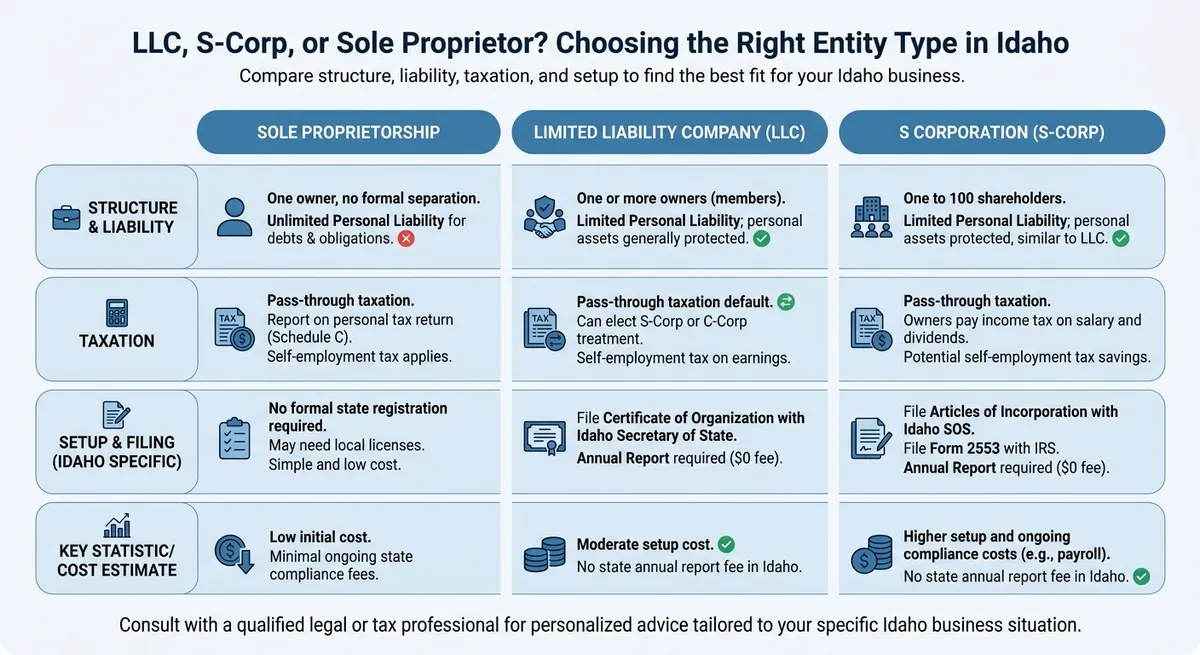
Key data and insights: LLC, S-Corp, or Sole Proprietor? Choosing the Right Entity Type in Idaho
Compare Idaho Formation Costs and Ongoing Compliance
Money matters when you pick a business structure. Let's break down what each option really costs in Idaho, both upfront and every year after.

Idaho Sole Proprietor Startup Costs
A sole proprietorship skips formal state filing fees. You don't file formation paperwork or pay the state to create this structure[13].
That said, you may still owe money for local business licenses, professional permits, or an assumed business name filing. Certain industries also need special registrations or insurance coverage.
Low startup cost sounds great. But it doesn't erase the risk tied to this structure.
Your personal assets stay exposed to business debts and lawsuits. That's why it pays to separate business finances from day one, even without a formal entity.
Idaho LLC Formation and Annual Report Requirements
Most filing guides list Idaho's online LLC formation fee at around $100[1]. Paper filings often cost more and take longer to process[2].
Idaho is frequently cited as having no fee for the required annual report[3]. Free doesn't mean optional, though. You still must file it every year to keep your LLC in good standing[7].
Beyond that report, you'll need a registered agent and a solid operating agreement. Keeping your state records current protects your liability protection and avoids administrative dissolution.
S-Corp Setup and Recurring Administrative Costs
An S-Corp election adds layers of cost beyond basic LLC formation. Expect fees for tax-election paperwork, payroll software, bookkeeping, and payroll tax filings[12].
You'll also need a tax professional to handle the more complex return each year[14]. Owner wages must stay separate from shareholder distributions, and the IRS watches this closely.
Potential tax savings sound appealing on paper. But you need to weigh those savings against the real cost of running payroll and extra compliance every single year.
Understand Idaho and Federal Tax Differences
Taxes work differently depending on how you set up your business. Federal rules stay the same no matter what state you're in. But Idaho adds its own layer on top.
| Feature | Sole Prop / Default LLC | S-Corp Election |
|---|---|---|
| Default federal reporting | Schedule C on personal return | Separate 1120-S return, K-1 to owner |
| Self-employment tax | ~15.3% on net profit[13] | Applies only to wages, not distributions[12] |
| Owner payroll | None required | Required, must be reasonable wage |
| Idaho income tax | Generally flows to the owner's personal return | Generally passes through to shareholders; Idaho filing and other applicable tax obligations may still apply |
| Common admin issues | Missed quarterly estimates | Payroll setup, underpaid wages |
Sole Proprietor and Default Single-Member LLC Taxes
If you run a sole proprietorship or a single-member LLC, your business profit lands on your personal tax return. You'll report it on Schedule C. There's no separate business tax return to file.
Because of this, you'll want to plan for estimated taxes throughout the year. Self-employment tax is commonly cited at roughly 15.3% of your net earnings, covering Social Security and Medicare
Evaluate Liability Protection, Privacy, and Business Credibility
Choosing a structure isn't just about taxes. It's also about how much personal risk you're willing to carry. Before you decide, look at the real risks that come with each option.

- Mixing personal and business money in one account
- Signing personal guarantees on loans or leases
- Using sloppy or incomplete contracts with clients
- Falling behind on payroll taxes
- Skipping insurance coverage you actually need
- Missing required state filings or annual reports
Personal Liability Risks of a Sole Proprietorship
As a sole proprietor, there's no legal wall between you and your business. If someone sues your business, they can go after your personal savings, car, or house.
Unpaid debts, contract disputes, and lawsuits can all reach you directly. Good insurance still matters no matter which structure you pickMatch the Entity to Profit, Growth, and Administrative Capacity
Picking a structure isn't just about paperwork. It's about matching your business today, and where it's headed, to the right setup.
Use this checklist before you decide:
- Assess your liability risk. Do you have clients, contracts, or inventory that could expose you to lawsuits?
- Estimate your stable annual profit, not just revenue.
- Calculate the compliance costs for each entity type[1].
- Determine if you'll need payroll, either for yourself or employees.
- Review your growth plans for the next two to three years.
- Talk to a tax professional before you file anything.
Profit consistency matters more than total revenue when you're modeling an S-Corp election. A business that earns $60,000 one year and $20,000 the next doesn't make a great S-Corp candidate, even if the average looks fine on paper.
When a Sole Proprietorship May Be Reasonable
If you're testing an idea or earning modest, inconsistent income, a sole proprietorship can work fine. It fits low-risk, owner-operated work with no employees or big contracts.
Simplicity has real value here. There's no separate business bank account required, no annual report, and no extra tax return. If you're paying contractors, though, get familiar with 1099-NEC requirements early, since that obligation applies no matter your entity type.
Revisit this choice as your revenue, risk, or client list grows.
When an LLC Is Often the Practical Default
An LLC is a flexible fit for many Idaho freelancers, consultants, and small teams. It separates your personal assets from business liability without heavy corporate formalities[3].
By default, an LLC keeps pass-through taxation. You can still elect S-Corp tax treatment later if it makes sense.
Keep your finances separate, file your annual report on time, and maintain clean books[9].
When to Model an S-Corp Election
A commonly cited starting point is $40,000 to $80,000 in net profit[12]. That's not a hard rule, just a range worth testing.
Compare potential payroll-tax savings against reasonable salary requirements, payroll processing, tax prep, and bookkeeping costs[14]. Also weigh your workload, hiring plans, and cash flow[13].
Run the numbers side by side before you file the election.
Build the Bookkeeping and Compliance System Your Entity Requires
Picking a structure is only step one. Your entity works well only if you keep your books clean and your filings current.
A simple checklist keeps you on track all year:
- Reconcile bank and credit-card accounts every month
- Review estimated tax payments each quarter
- File payroll tax deposits and reports on schedule
- Keep W-9s and contract records for every contractor
- Review sales-tax collection and filing duties
- Track your Idaho annual report deadline
- Prepare a year-end tax package for your accountant
Separate Business and Personal Finances From Day One
Open a business bank account and credit card right away. Don't mix personal purchases with business spending.
Document money you put into the business as an owner contribution. Categorize expenses as you go, not once a year in a panic.
Keeping business and personal finances separate protects your liability shield, speeds up tax time, and gives you a clear view of cash flow. For a full walkthrough, check out this A Practical Idaho Entity-Selection Decision Guide
You've read the details. Now let's make this simple. Here are three paths based on your income, risk, and how much admin work you're willing to do.
Tax rules change every year, and your income will change too. Treat this as a starting point, not a forever decision.
Choose Simplicity When Risk and Profit Are Limited
A sole proprietorship works fine for low-risk, early-stage work, such as freelance writing, tutoring, or small consulting gigs run by one person[13].
Even so, keep business and personal money separate. Use a dedicated bank account, get basic liability insurance, and use written contracts with clients.
Set a review date. Check your numbers every year, especially once profit passes a comfortable buffer above your living costs.
Choose an LLC When Flexibility and Separation Matter
An LLC gives you a legal wall between business debts and personal assets. Idaho's filing costs are also fairly manageable compared with those in other states[1][2].
An LLC won't save you if you skip insurance or use handshake deals instead of contracts. The legal structure protects you only when you run things properly.
If you plan to grow, an LLC also sets you up well. You can learn more in our guide to starting an LLC in Idaho before deciding on S-Corp taxation down the road.
Choose S-Corp Taxation Only After the Numbers Support It
S-Corp taxation can lower your self-employment tax bill once profits climb high enough[12]. But it comes with real costs: payroll runs, extra bookkeeping, and a separate tax return[14].
- Compare estimated tax savings with payroll and accounting fees
- Confirm your profit is steady enough to support a reasonable owner salary
- Talk to a tax professional before filing the election
If the math works, this path can pay off. If it doesn't, you can always revisit it once you learn how to start an LLC in Idaho the right way first.
Frequently Asked Questions
Is an LLC or S-Corp better for a small business in Idaho?
This isn't really an either-or choice. An LLC is a legal structure that protects your personal assets, while S-Corp is a tax election you can apply to that LLC once it's making decent money. The right pick depends on your profit level, whether you can handle payroll paperwork, and how much extra admin cost you're willing to take on.
Rather than following a blanket rule, run a tax projection comparing standard LLC taxation with an S-Corp election. The savings only show up above a certain profit threshold.
How much does it cost to form and maintain an LLC in Idaho?
Filing online with the Idaho Secretary of State runs about $100, and paper filings can cost a bit more, so online is the cheaper route. Idaho is one of the few states that doesn't charge a fee for the annual report, though you still have to file it every year or risk losing good standing. Beyond that, budget for a registered agent, any required business licenses, and ongoing bookkeeping. Idaho also skips a separate franchise tax on LLCs, but if you elect corporate taxation, you'll owe the state's corporate income tax, which is currently 5.3% after a 2025 rate reduction from 5.695% (applied retroactively to January 1, 2025), so check for the latest rate before filing.
When should an Idaho LLC consider electing S-Corp taxation?
You'll often hear the $40,000 to $80,000 net-profit range described as the point where S-Corp status starts making sense, but treat it as a rough starting line, not a rule. An S-corporation may reduce employment-tax exposure in some circumstances because properly reported shareholder distributions generally are not wages, but shareholder-employees must receive reasonable compensation and the actual benefit depends on the business's facts and added compliance costs. That salary has to reflect fair market pay for your work, and running payroll adds real cost and paperwork. Before switching, weigh those added costs against your projected savings, and talk to a tax pro if your profits are steady enough to make the math work.
Conclusion
So, which structure fits your business? A sole proprietorship keeps things simple, but it leaves your personal assets exposed if something goes wrong. An Idaho LLC gives most small business owners a solid middle ground: real liability protection, flexible tax options, and dues that won't break the bank. S-Corp taxation can save you money on self-employment taxes once your profits are consistently high, but only if those savings outweigh the extra payroll and paperwork it demands.
Whatever you choose, the basics don't change. Keep clean books, separate your business and personal money, file on time, and get professional tax advice before you decide.
Ready to get organized? Check out Tidy Ledgers Bookkeeping's Idaho business resources to start sorting your finances. Then reach out to Tidy Ledgers Bookkeeping for help with bookkeeping, payroll, and compliance, and loop in a qualified tax professional to confirm the entity choice that fits your business best.
Related Articles
- GuideStarting a business in Idaho: a bookkeeping and compliance checklistA practical checklist for new Idaho business owners, from registering with the Secretary of State to setting up clean books before your first sale.Read the guide
- GuideSeparating Business And Personal Finances: Fix the MixLearn how to separate business and personal finances, correct commingled transactions, and build a clean monthly bookkeeping routine.Read the guide
- GuideIdaho sales and use tax: a plain guide for small businessesIdaho's sales and use tax is 6%, but the rules around permits, filing schedules, use tax, and resort-city add-ons trip up plenty of good owners. Here's how it works.Read the guide
- PayrollAccurate payroll with Idaho withholding, unemployment, and W-2 / 1099 filings handled for you
- Financial Reporting & InsightsClear monthly reports, AP/AR, 1099s, and KPIs that turn your numbers into confident decisions
- GuideBookkeeper vs accountant: what is the difference?A bookkeeper keeps your records current month to month, while a CPA or accountant files taxes and gives higher-level advice. Here is how the two roles fit together.Read the guide
Common questions
Is an LLC or S-Corp better for a small business in Idaho?
This isn't really an either-or choice. An LLC is a legal structure that protects your personal assets, while S-Corp is a tax election you can apply to that LLC once it's making decent money. The right pick depends on your profit level, whether you can handle payroll paperwork, and how much extra admin cost you're willing to take on. Rather than following a blanket rule, run a tax projection comparing straight LLC taxation against an S-Corp election, since the savings only show up above a certain profit threshold.
How much does it cost to form and maintain an LLC in Idaho?
Filing online with the Idaho Secretary of State runs about $100, and paper filings can cost a bit more, so online is the cheaper route. Idaho is one of the few states that doesn't charge a fee for the annual report, though you still have to file it every year or risk losing good standing. Beyond that, budget for a registered agent, any required business licenses, and ongoing bookkeeping. Idaho also skips a separate franchise tax on LLCs, but if you elect corporate taxation, you'll owe the state's corporate income tax, which has hovered around 5.5-6%.
When should an Idaho LLC consider electing S-Corp taxation?
You'll often hear the $40,000 to $80,000 net-profit range thrown around as the point where S-Corp status starts making sense, but treat that as a rough starting line, not a rule. The savings come from paying yourself a reasonable salary and taking the rest as distributions, which can cut your self-employment tax exposure below the standard 15.3% hit sole proprietors pay on all their profit. But that salary has to reflect fair market pay for your work, and running payroll adds real cost and paperwork. Before switching, weigh those added costs against your projected savings, and talk to a tax pro if your profits are steady enough to make the math work.

Want this handled for you?
Get a free, no-obligation quote and a quick health check of where your books stand. We reply within one business day. No pitch, no pressure.