

Key Takeaways
- Frequent catch-up work, unreconciled accounts, and missing documentation show that DIY bookkeeping is no longer sustainable.
- Accurate books support tax compliance, cash-flow planning, financing decisions, and business growth.
- Hiring a bookkeeper may be more practical than adding software, working longer hours, or relying on incomplete records.
- A professional bookkeeping review can identify errors, clean up QuickBooks, and establish reliable monthly reporting.
DIY bookkeeping can work when your business is small, simple, and easy to track. Many owners start that way to save money and stay close to every dollar coming in and going out. It feels manageable at first, even smart.
But growth changes things faster than most owners expect. Invoices pile up, records fall behind, and small mistakes turn into real money problems. The IRS requires accurate, organized records for a reason, and sloppy books can cost you at tax time (1).
How do you know when it's time to get help? Here are the warning signs and how Tidy Ledgers Bookkeeping supports Idaho business owners through that shift.
Why DIY Bookkeeping Stops Working as a Business Grows
A spreadsheet works fine for a brand-new, one-person business. But growth changes the math fast. Here's a quick look at how things shift:
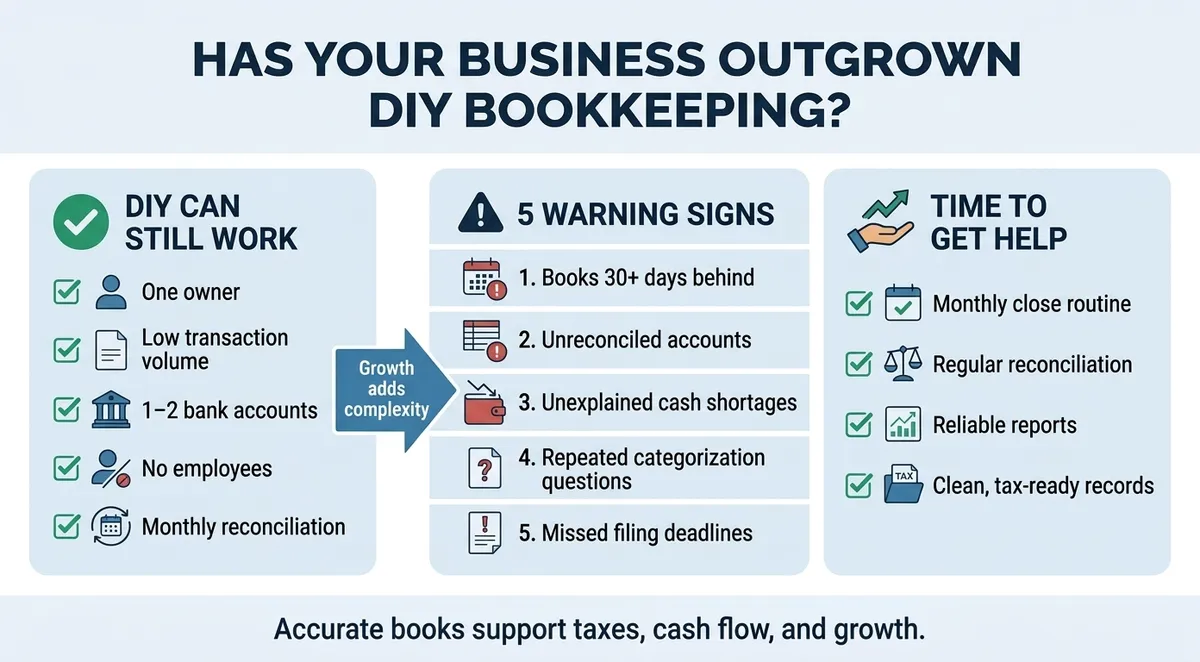

- Manageable DIY setup: A few dozen transactions a month, one bank account, and simple cash-in-cash-out tracking.
- Growing-business setup: Multiple accounts, several employees, sales tax across states, and reports you need to run the business.
- Manageable DIY setup: Owner reconciles once a month without much effort.
- Growing-business setup: Weekly reconciliation becomes necessary to catch errors before they pile up.
At some point, it makes sense to compare outsourced versus in-house bookkeeping options instead of stretching the owner even thinner.
The difference between simple recordkeeping and financial management
Bookkeeping means recording, categorizing, reconciling, and storing your business transactions. That part sounds simple. But a growing business needs more than data entry.
It needs timely reports, internal controls, and numbers you can use to make decisions. The IRS says businesses must keep records that support income, expenses, and deductions claimed on tax returns[1][5]. That's the baseline, not the finish line.
Growth creates more transactions and more room for error
New customers, vendors, and employees. New payment processors, subscriptions, and maybe a second location. Each one adds complexity to your books.
Sales tax rules alone can get messy once you sell across state lines. Inconsistent categorization and late reconciliation can quietly distort your real profit and cash position. The Small Business Administration encourages owners to treat active financial management as a core part of running and growing a business, though this is a general paraphrase of SBA guidance rather than a direct quote[3].
Many owners already feel this pressure. According to a Consumer Financial Protection Bureau survey of small business owners, many report real strain around managing day-to-day cash flow and planning ahead[2].
The real cost of keeping bookkeeping on the back burner
Hiring help has a visible price tag. Staying DIY feels free, but it isn't. The hidden costs show up as lost owner time, missed deductions, late fees, and bad decisions based on bad data.
Stress adds up too, especially during tax season. The real test isn't whether you entered every transaction. It's whether your books are accurate and current enough to guide real decisions.
Proper recordkeeping can help businesses prepare tax filings and substantiate reported income and expenses[5]. If your records can't answer basic questions about profit or cash on hand, your system has outgrown you.
5 Signs Your Business Has Outgrown DIY Bookkeeping
Some warning signs are loud. Others creep up slowly until a tax deadline or loan application forces the issue. Here's a quick way to spot the pattern before it costs you.
| Warning Sign | Likely Bookkeeping Problem | Business Impact | Recommended Next Step |
|---|---|---|---|
| Books 30+ days behind | No consistent close process | Can't see true cash position | Set up a monthly close routine |
| Unreconciled accounts | Bank and credit card data never matched | Errors go unnoticed for months | Reconcile accounts weekly or monthly |
| Unexplained cash shortages | No tracking of draws or transfers | Owner may not trust the numbers | Review cash-flow reports regularly |
| Repeated categorization questions | Chart of accounts is unclear | Reports may not reflect reality | Clean up and standardize categories |
| Missed filing deadlines | Records are not ready when needed | Penalties and added stress may result | Keep records current year-round |
How Business Complexity Changes the Bookkeeping Equation
Growth doesn't just mean bigger numbers. It means more moving parts.
Several changes can push your bookkeeping needs past what a spreadsheet or basic software can handle:
- Hiring your first employee
- Bringing on contractors or freelancers
- Carrying inventory
- Operating more than one location
- Selling through an online store or marketplace
- Taking on a business loan or line of credit
- Watching unpaid invoices pile up
- Switching your entity type or tax structure
Any one of these can add real work. A few together can overwhelm a part-time system fast.
More revenue does not automatically mean healthier finances
It feels good to see sales climb. But more sales often bring more bills, too.
You may need to buy more inventory, pay more payroll, and collect more sales tax. Cash can get tight even while revenue looks strong on paper.
DIY Bookkeeping vs. Professional Bookkeeping Support
Before you pick a path, check where you stand right now. This quick list can help.

- Can you close your books within about five business days of month-end, every month? (A five-day close is a commonly cited industry best-practice benchmark, though not a universal or official standard.)
- Do you know your profit margin without opening three different apps?
- Have you added payroll, contractors, or a second revenue stream recently?
- Do you dread reconciling accounts, or just skip it some months?
- Would a second set of eyes catch mistakes you've missed?
If you hesitated on more than one question, it's worth comparing your options side by side.
When DIY bookkeeping can still be a reasonable choice
DIY works best for a simple setup. Think one owner, low transaction volume, no employees, and one or two bank accounts.
Straightforward revenue helps too. If you invoice a handful of clients each month, tracking it yourself is manageable.
But DIY still takes real effort. The IRS expects business owners to keep accurate, organized records that support their tax filings[1].
What a Professional Bookkeeper Should Do for Your Business
A good bookkeeper doesn't just enter numbers. They build a routine that keeps your books clean every single month. Here's what that process should look like.
Establish a reliable monthly bookkeeping routine
A solid bookkeeping process follows the same steps every month. Here's a typical workflow:
- Collect receipts, invoices, and bank statements
- Categorize each transaction correctly
- Reconcile bank and credit card accounts
- Review unusual or large transactions
- Close the books for the month
- Deliver reports and flag anything that needs attention
This kind of routine matters more than occasional catch-up sessions. The IRS expects business owners to keep records that clearly support income and expenses[5].
How to Transition Away From DIY Bookkeeping Without Losing Control
Handing off your books feels risky. You've managed every number yourself for years. But a good transition plan keeps you in charge while someone else does the heavy lifting.
Use a simple checklist. Cover your records, who gets access, what work is included, deadlines, how you'll get reports, and how you'll stay in touch. This keeps the handoff clean and avoids surprises.
Prepare your records and define the scope of help
Start by gathering what a new bookkeeper will need. The IRS recommends keeping organized records of income and expenses[1].
Frequently Asked Questions
At what point should I stop doing my own bookkeeping?
There's no magic revenue number where DIY bookkeeping stops working. Instead, look at signs like transaction volume, how complex your business has gotten, and whether your books are current and accurate. If you can't produce a reliable monthly report, or if bookkeeping is eating hours you need for running the business, that's your answer. Compliance risk matters too: missed deadlines and payroll errors add up fast once you're busier.
Is it cheaper to hire a bookkeeper or keep doing bookkeeping myself?
On paper, doing it yourself looks free, but it rarely is. Your time has a cost, and mistakes, late filings, and delayed decisions can cost even more than a bookkeeper's fee. Pricing for bookkeeping services reportedly varies a lot based on how much work you need done, so a smaller monthly service or a one-time review might fit better than a full handoff. If you're not ready to outsource everything, a periodic cleanup or quarterly review can bridge the gap.
Can a bookkeeper fix my QuickBooks file if it is already messy?
Yes, most bookkeepers deal with messy files regularly. They can review your accounts, reconcile past transactions, and rebuild your chart of accounts so your reports actually make sense. If the mess has already affected your tax filings, it's smart to loop in a tax professional too, since some fixes touch both bookkeeping and tax reporting. Once things are cleaned up, a good bookkeeper will also set up a recurring process so you don't end up back in the same spot.
Conclusion
If you're always playing catch-up, missing receipts, or guessing at your bank balance, that's your answer. DIY bookkeeping has done its job, and now it's holding you back. These aren't small annoyances. They're signs your business has grown past the point where spreadsheets and good intentions can keep up.
Clean, accurate books aren't just about taxes. They give you a real read on cash flow, back you up when lenders ask questions, and let you make decisions based on facts instead of guesswork. The good news?
You don't have to fix everything overnight. A cleanup project, monthly support, or a hybrid setup can ease the shift without turning your routine upside down.
If your books are behind, confusing, or eating up time you'd rather spend running your business, reach out to Tidy Ledgers Bookkeeping. We'll talk through a bookkeeping review, QuickBooks cleanup, or ongoing monthly support built around what you actually need.
Related Articles
- How to Choose a Bookkeeper in Idaho — Picking a bookkeeper is a trust decision, not just a price decision. Here are the questions to ask about certification, security, Idaho tax knowledge, responsiveness, pricing, and references before you hand over your books.
- How to Switch Bookkeepers Without Losing Control: A 30-Day Handoff Checklist — Changing bookkeepers should be a controlled handoff, not a rushed exchange of logins. This checklist helps owners protect access, records, deadlines, and the first close with a new provider.
- Month-End Bookkeeping Checklist for Small Businesses — A practical monthly routine for reconciling accounts, reviewing financial reports, documenting open items, and closing cleaner books.
- Behind on Your Books? A Catch-Up Bookkeeping Checklist — A calm, step-by-step checklist for business owners who are behind on their books, covering statements, reconciliation, categories, sales tax, payroll, and getting tax-ready.
- 10 Common QuickBooks Online Errors and How to Fix Them — Most QuickBooks Online errors involve bank feeds, duplicate transactions, payroll connections, user access, or reconciliation discrepancies.
- Monthly Bookkeeping — Categorized transactions, reconciled accounts, and clean monthly financials, closed on time, every month.
Common questions
At what point should I stop doing my own bookkeeping?
There's no magic revenue number where DIY bookkeeping stops working. Instead, look at signs like transaction volume, how complex your business has gotten, and whether your books are current and accurate. If you can't produce a reliable monthly report, or if bookkeeping is eating hours you need for running the business, that's your answer. Compliance risk matters too: missed deadlines and payroll errors add up fast once you're busier.
Is it cheaper to hire a bookkeeper or keep doing bookkeeping myself?
On paper, doing it yourself looks free, but it rarely is. Your time has a cost, and mistakes, late filings, and delayed decisions can cost even more than a bookkeeper's fee. Pricing for bookkeeping services varies a lot based on how much work you need done, so a smaller monthly service or a one-time review might fit better than a full handoff. If you're not ready to outsource everything, a periodic cleanup or quarterly review can bridge the gap.
Can a bookkeeper fix my QuickBooks file if it is already messy?
Yes, most bookkeepers deal with messy files regularly. They can review your accounts, reconcile past transactions, and rebuild your chart of accounts so your reports actually make sense. If the mess has already affected your tax filings, it's smart to loop in a tax professional too, since some fixes touch both bookkeeping and tax reporting. Once things are cleaned up, a good bookkeeper will also set up a recurring process so you don't end up back in the same spot.

Want this handled for you?
Get a free, no-obligation quote and a quick health check of where your books stand. We reply within one business day. No pitch, no pressure.